Showing posts with label 90s. Show all posts

Sunday, July 5, 2015

Oeuvre: Tim Burton - Sleepy Hollow

The Legend of Sleepy Hollow was one of my favorite short stories as a boy.  Likewise, the animated Disney short of the same name was in constant rotation around the Halloween season.  The chilling tale of the superstitious schoolteacher, Ichabod Crane and his mysterious meeting with the Headless Horsemen aroused my curiosity and fired up my imagination.

So, how does Tim Burton's film compare?  The movie, Sleepy Hollow, may have a streamlined title but it also has a far more complicated plot.
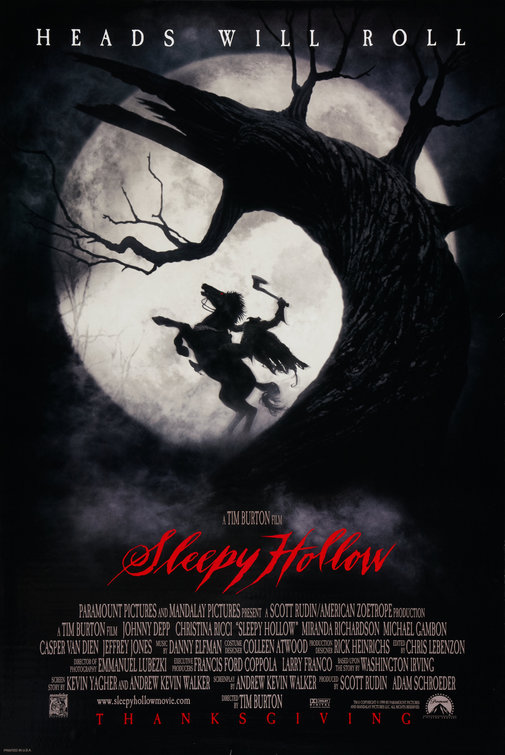
Sleepy Hollow Movie Poster

At the turn of the 19th century, man of science, Constable Ichabod Crane (Johnny Depp) is sent to a small, Dutch village to investigate a series of brutal beheadings.  The townsfolk believe that the killer is not of flesh and blood, but a hessian from the Revolutionary War they call the Headless Horseman, who has risen and is on the hunt for fresh heads.  Determined to find the true culprit of these crimes, Ichabod uncovers a sinister conspiracy deep within the heart of Sleepy Hollow, and maybe even... beyond the grave.

Andrew Kevin Walker and make-up effects designer Kevin Yagher conceived of this adaptation as a period piece slasher film.  This comes as no surprise, given that Walker also wrote Se7en.

Johnny Depp performs ably as the capable but cowardly Ichabod Crane, now constable instead of school teacher.  Also considered for the role were Brad Pitt, Liam Neeson, and Daniel Day-Lewis.  Depp is slightly goofier than Neeson or DD Lewis might have been and maybe if the film had been closer to the source material, they would have been better choices.  Unsurprisingly, Depp wanted a prosthetic nose and ears to match the description of the character.  Equally unsurprisingly, the studio refused.  He gives a performance that's vaguely feminine and fragile and while he's far too pretty to fit in with the rest of his surroundings, its always fun to watch Depp swing for the fences.

Christina Ricci is cast as Katrina Van Tassel and she is given more development than her character ever had in the book.  And yet, there's still nothing to her character.  Its some sort of mathematical paradox in which zero is somehow greater than zero.  I suppose she spurns Ichabod later but that's about it.

Brom Bones (now named Brom Van Brunt) is Ichabod's romantic rival but his role in the story is chopped down immensely, if you'll pardon the pun.  Ichabod's first run-in with the Horseman and the chase to the bridge remains intact, and even contains one of the possible endings of the original story, but it appears around the halfway point of the film.  Apart from that Brom acts more as the Jock in a slasher film, than the Gaston-esque figure he is in the book.

Apart from that, we are given a whole new cast of characters.  Baltus Van Tassel, Magistrate Philipse, Doctor Lancaster, Reverend Steenwyck, Widow Winship, Notary Hardenbrook, all great names, are played by an embarrassingly talented cast including Michael Gambon, Richard Griffiths, Ian McDiarmid, Jeffrey Jones, Michael Gough, Christopher Lee, and Miranda Richardson, most of whom play town elders and all of whom have something to hide.


Much is removed from Washington Irving's classic.  However, the tone of the film remains the same.  Eerie is the best word to describe it.  As I've said previously, the book is reshaped from a thrilling horror to a horror thriller.  My frustration at the changes aside, I have to concede that the film still works.  Burton turned this slasher film into a Hammer Horror film, even bringing in Hammer alumni such as Christopher Lee and Michael Gough.  The action and the kills are well shot and when the mystery really picks up, there is a modern energy that meshes well with the period setting.

"Their heads were not found severed..." warns Reverend Steenwyck, ominously.  "Their heads were not found at all."  There is a fantastic atmosphere that pervades most of this film.

The production design by Rick Heinrichs, from the imposing town halls, to the spindly scarecrows in a cornfield, to the twisted, dead tree in the middle of a forest are all straight out of what I like to call "horror by candlelight."  It all looks like something out of an Edgar Allen Poe novel.

The cinematography, shot by none other than the immeasurable Immanuel Lubezki is breathtaking and haunting.  His use of darkness and fog is classic horror the way it was meant to be seen.  Burton's frequent collaborator, Danny Elfman steps up to the plate in a big way.  Horror films are particularly difficult to write music for.  Low and ominous is an easy direction but its damn near impossible to make anything that stands out.  Almost any track would fit perfectly in a campfire setting.  He elevates the still and unnerving cinematography and provides a soundtrack that sends chills down your spine.

There is only one element of the movie I outright object to and that is the ending, which essentially amounts to a climb up a wind-mill (gotta milk that Dutch heritage for all it's worth) and a horse chase with the Headless Horseman.  Why does it bother me?  Well, I'll tell you.


SPOILERS FOR THE LEGEND OF SLEEPY HOLLOW BELOW!!!

The short story is COMPLETELY different!  In Washington Irving's original tale, Ichabod Crane is a lanky, gawky, superstitious schoolteacher who comes to Sleepy Hollow to... well... teach school.  Despite his awkward appearance, Ichabod is surprisingly charming and attracts the eye of every woman in town, including Katrina Van Tassel, a young woman and heir to her father's considerable fortune.  Ichabod also has an appetite and daydreams about wedding Katrina so that, when her father passes away, he can inherit the fortune and eat, and eat, and eat.

All of this becomes a point of contention to the local bully, Brom Bones, who also seeks Katrina's hand.  He attempts to embarrass Ichabod, though the pranks fail to dissuade him.

Then, on a cold, autumn night, Ichabod attends a party at the Van Tassel's.  There, Brom tells everyone the ghost story of the Headless Horseman, an evil spirit who lost his head and seeks others to take it's place.  He warns that if anyone sees this specter, they must make for the bridge next to the old burying ground, where the Horseman will disappear.

That night, on his lonely ride home, Ichabod sees a man in the distance on horseback.  The massive man approaches him and Crane sees that the man has no head.  The Horseman charges Ichabod and chases him through the forest, with Ichabod running for his life.  Ichabod crosses the bridge and watches in horror as the Headless Horseman crosses the bridge and throws a severed head at Ichabod's face.

The next day, Ichabod is gone.  All that remains is his horse, a trampled saddle, a hat, and a broken pumpkin.  Brom Bones marries Katrina.  Did Ichabod truly run into the Headless Horseman that night?  Was he dragged to hell?  Or was it merely Brom Bones in disguise?  And if it were, did Ichabod flee the city?  Or was he savagely murdered and his body hidden?  The true fate of Ichabod Crane remains a mystery.

The End.


To me, that ending is WAY scarier than any ferris wheel fight scene.  The idea that our hero could be dispatched and we'll never know the truth is frightening.  I suspect that as children, we all have a fear that we will be taken and nobody will know what happened to us.  I understand that a story about a schoolteacher and only one supposed murder can't sustain a feature film but I prefer this sinister and ambiguous conclusion.

Its the movie's lame ending and a tired, bland love story between Ichabod and Katrina, that prevent this movie from being a horror classic.  That said, I still think that its a lot of fun and if you're in the mood for something to watch on Halloween that has that October spirit, I think this is a fun film to check out.

Thursday, June 11, 2015

Oeuvre: Tim Burton - Mars Attacks

Tim Burton must have been inspired after binge watching the films of Ed Wood.  How else do you explain this throwback to the sci-fi schlock of the fifties that is MARS ATTCKS?


While Batman drew upon decades of rich, varied source materials, and Ed Wood was adapted from a biography, Mars Attacks is based on... trading cards.  And boy does it show.  How can I tell?  Because the story has no story.  Or maybe it has too much story.  Let's unpack this.

The "plot" is that hideous Martians visit Earth, at first, in peace (or maybe not, its never clear), and then with great malice.  During the discovery and subsequent invasion, we follow a slew of colorful characters, performed by one of the greatest casts ever assembled, including a pervy assistant to the President played by Martin Short, a jealous reporter played by Michael J. Fox, a frustrated bus driver played by Pam Grier, a snobbish First Lady played by Glenn Close, her precocious daughter played by Natalie Portman, a quiet, misunderstood teenager played by Lukas Haas, his oblivious grandma played by Sylvia Sidney, a redneck soldier played by Jack Black, Tom Jones played by Tom Jones, and Danny DeVito as a rude gambler named Rude Gambler.

But the main characters are Jack Nicholson as both the President of the United States and as an obnoxious casino owner, Annette Bening as a delightful hippie, a chihuahua-toting entertainment news reporter played by Sarah Jessica Parker, and her unlikely love interest, Pierce Brosnan as a suave Professor who smokes a pipe.

All of these actors live and die by the material written for them, which varies to a dangerously uneven degree.  Of this monumental cast, I'd say Nicholson, Grier, Bening, and Brosnan come out shining.


When the movie is at it's strongest, it skewers those silly science fiction flicks Hollywood used to crank out.  That's one of the reasons Pierce Brosnan is so successful.  His role is the most 50's B-movie of them all.  He squints off in the middle distance, pondering man's place amongst the cosmos.  He performs an alien autopsy in a round, white room, wearing scrubs and a bubble helmet.  He reaches into the alien's head and pulls out Nickelodeon-green slime.  And he's almost never seen without his pipe.

But all too soon, we reach the breaking point of the film.  Namely that Mars Attacks doesn't know what to do after Mars attacks.  Before, the movie was a comic sendup, but it builds and then crumbles into disappointing series of lame gags.  The Martians have no purpose, no end goal, and as a result, they are subjected to cartoon gimmicks that make no sense.  Why do the Martians ogle a women like horny teenagers?  Why do they pose for a family photo in front of the Taj Mahal?  Why do they use the Easter Island heads as bowling pins?  Do Martians have family vacations and cheesy group photos on Mars?  Do they have bowling?  Is it possible that we are, in fact, not so different after all?  No, its just lazy writing.

The problem is an obvious narrative issue.  The story simply lacks focus.  Brosnan and Sarah Jessica Parker have a great blossoming romance, even as they are experimented on aboard the alien spaceship.  But once there, they have nothing to do with the plot.  This is made all the more frustrating by a hint of a romance in the last 2 minutes of the movie between two characters who SHOULD have been the primary focus of the film, namely Lukas Haas and Natalie Portman.  Haas has the closest thing anyone has to a narrative ark and its a shame that the movie didn't choose to put him front and center.

The special effects in this film are sometimes great and sometimes terrible and its hard to tell when it's intentional and when its a failing.  The aliens are an unsettling sight to behold but as I mentioned, they're boring at best and irritating at worst.


The big takeaway from Mars Attacks is that it is good when it needs to be good, and bad when it needs to be bad, and sometimes its the other way around.


Thursday, May 28, 2015

Oeuvre: Tim Burton - Ed Wood

Ed Wood is Tim Burton's Schindler's List.  There.  I said it.


Lets dive right in, shall we?  In the early 50's, a young filmmaker named Ed struggles to make movies by any means necessary.  Undeterred by repeat failures, he is convinced his luck has changed when he meets the once great, now forgotten horror star, Bela Lugosi.  Together, the pair make some of the worst films of all time.

There are two types of Ed Wood fans; those who discovered his objectively terrible films on their own, and those who discovered him through this film.  Some are the former.  Most are the latter. Anyone who says otherwise is a liar.

The film shows considerable maturity for Burton.  Saddled with the responsibility of telling the story of a real person's life, Burton stays away from the stop-motion animation and gothic imagery that has defined his career up to this point.  Instead, he makes a film "the Ed Wood way."  The production design by Tom Duffield recreates Wood's reality in painstaking detail and the black and white cinematography by Stefan Czapsky captures it beautifully.  You're not just in Ed's world, you see it from his eyes.


They say we love characters for trying more than for their success.  Ed may be the poster child for that ideal.  The screenplay written by Scott Alexander and Larry Karaszewski, based on the book by Rudolph Grey certainly thinks so.  We're always in Wood's corner.  We cringe as he gets knocked down and we cheer for him each and every time he gets back up.

The film boasts an impressive cast including Sarah Jessica Parker, Patricia Arquette, Jeffrey Jones, Bill Murray (who regrettably has never appeared in another Burton film) and a delightful cameo by Vincent D'Onofrio and Maurice LaMarche simultaneously as Orson Welles.

Martin Landau is magnetic as the foul-mouthed Hungarian.  His relationship with Ed, as they grow from idolized admiration to mutual appreciation, is tragically beautiful.  Both are striving for respect and legacy.  Wood, for a respect he has never achieved and Lugosi for a respect he once possessed.  Never meet your heroes, kids.

But the real star of the film is Johnny Depp as the titular Ed Wood in what may be the finest performance of his career (not counting Captain Jack in Pirates 1).  He imbues the character with delicate sensitivity.  He looks at everything and everyone with the energetic wonder of a child.  Watching Depp going over dailies of Lugosi stumbling through a scene, you'd think he was watching the second coming of Christ.  He has no self-critic, no voice in his head asking if what he's making is total shit.  He can't afford it.


Ed surrounds himself with failures, not to prop himself up, but because nobody of substance would agree to work with him.  They become his friends, compatriots, and accomplices as he passionately convinces them to steal giant, robotic squids and get baptized in a swimming pool.  And when Wood reveals himself as a transvestite, very risqué back then, they embrace him with loving arms, laughing with him.  They form a loyal circus group of badness that you want to join.

Ed Wood has had a hard time finding its crowd.  Its the film that most casual Tim Burton fans, I'm talking about the Hot Topic crowd here, seem to have missed.  Whereas, more serious cinefiles, those who stick up their noses at Batman or Sleepy Hollow, praise as his best.  Whichever way you look at it, whichever camp you find yourself in, its certainly a gem.

Under the care of almost any other director or written by any other screenwriter, this story could be nothing more than a series of potshots at the character but that's not the case here.  Sure, there are more than a few jabs at the hapless filmmaker and his crew, but at its heart, this is a story about determination and pursuit of one's dreams.  The film is never cruel.  Rather, its filled with admiration and respect for a man who was a terrible artist, but was still a man, with hopes and dreams, who made friends and watched people die.  He felt love and he felt heartache.  In that way, Ed Wood is one of the most human films I've ever seen.

Despite being critically well received and winning several Academy Awards, the film was a box office flop.  No accounting for taste, I suppose.  Check it out, immediately.


Saturday, May 16, 2015

Oeuvre: Tim Burton - Batman Returns

After the monster smash that was BATMAN, Warner Bros was willing to do anything to get Burton back at the helm but Burton had moved on.  The tradeoff: he could do whatever he wanted with this one.  So how does one of Hollywood's most visually inventive directors follow up one of the most financially successful films of all time with a massive budget and free reign?  He makes one of the most unique super hero films of all time.  He makes BATMAN RETURNS.


The plot is all over the map, as though Burton and his screenwriters got bored every 15 pages and decided to go a completely different direction.  So here we go...

It's Christmas time and a corrupt businessman named Max Shreck has bribed all of the politicians to look the other way as his new power plant drains Gotham of all its energy.  Meanwhile, living in the sewers under the streets, is a deformed man named Oswald Cobblepot.  Abandoned and left for dead by his parents, Cobblepot was saved by either the Circus or an abandoned zoo, its never clear which.  Cobblepot blackmails Shreck for control and the two concoct a plan to elect the hideous Penguin Mayor of Gotham City.  At the same time, Shreck's shy but intelligent secretary, Selina Kyle discovers Schrek's fiendish plot and he throws her out a window.  She lives and decides she's had enough of men pushing her around.  She returns from the dead to seek revenge on all mankind as the vicious Catwoman.  Oh, and Batman's in it.

Narratively, it's a mess.  The stories work independently and there are no plot points that I would call "bad" but as a collective whole, the story simply doesn't work.  There is also a subplot about the Penguin deciding to kill all of Gotham's first born sons.  Then all children in general.  And an attempt to turn the Batmobile into a bomb.  And Wayne Corp deciding whether or not to do business with Shreck.  And a duel relationship between Batman and Catwoman/Bruce Wayne and Selina Kyle.  It's bananas.


Michael Keaton returns as Bruce Wayne and Batman and he makes a strong argument for being the best Batman ever to grace the silver screen.  He is quiet, understated, and still trying to come to grips with how to be Batman and live a normal life.

One of the most common complaints about this movie is that there are too many villains.  The problem isn't the number but that their stories lack focus.  The Dark Knight Rises had the same problem, but at least the villains in Returns are interesting.  As the Penguin, we have Danny DeVito in the role he was born to play.  Correction: he was born to play Burton's Penguin.  He's gross.  He's violent.  He's frightening.  He's perverted.  He's hilarious.

The role of Catwoman was coveted by virtually every woman in town.  Legend has it, Sean Young dressed up in a cat suit and walked through the Warner Bros lot before barging into the Producer's office and declaring, "meow! I am Catwoman!"  The role eventually went to Michelle Pfeiffer and I don't care what any of the Nolan Fans say, Pfeiffer has yet to be beaten as Catwoman.  She plays both parts as extreme as possible and it works.  Her character carries an understandable grudge against all the men who have held women down for far too long (more on that later).  Her suit, which she had to be vacuumed into before every take, is a thing of genius, making her look like the Bride of Frankenstein had an S&M fetish.  Like everything else in this movie, she is far removed from the source material, but what is on screen is memorable and iconic.  Her performance single-handedly thrust countless boys into puberty.  Too much information?  Probably.


All of the villains are interesting creations, except for Shreck played by Christopher Walken.  Does anyone ever believe him as a human being?  I don't know if Shreck was a part of the comics (although Max Shreck is the name of the actor who played Nosferatu years ago so I'm guessing no), but he only works as a stitch in this movie.  He ties the villains together and while the film gets some of its best satirical pot shots at his expense, he only adds to the bloated feeling throughout.

So why do I like this movie?

Well, despite its loopy, convoluted story, I just can't ignore what a unique film this turned out to be.  It exists in a strange spectrum.  Only a studio's desperation to keep Burton happy and a director determined to not just repeat himself could have lead to a film with this tone. There is a dark spine in this movie, as crooked as it may be.  It's a spine with child murder and perverted sexual politics.  Its comic book origins are firmly in place when the Penguin ascends into a One Percenter Christmas party in a giant Rubber Duckie and when a band of deranged Circus performers attempt to abduct all the first born children of Gotham's elite, but it also contains banter about overpaid security guards and fillings of voids, if ya know what I mean.


Then there is the discussion of women's rights as everyone but Bruce Wayne view women as sexual objects.  Shreck openly debases the obviously intelligent Selina but tells his fellow board members, "she does make a hell of a cup of coffee."  Even as the Penguin's control of Gotham tightens, he can't help but look at his admirers with the lust of a man who has never been touched and practically calls Catwoman a cock tease.  Meanwhile, Catwoman herself is fed up, not just of all the men in her life, but with women who act as damsels in distress.  Its refreshing to see a character confront these concepts so aggressively and unapologetically.  As Batman punches her in the face she cries, "how could you? I'm a woman!" As Batman tries to help her up, apologizing, she kicks the legs out from under him, stating, "as I was saying, I'm a woman and can't be taken for granted."  Hear me roar, indeed.

McDonalds famously cancelled their toy deal with Warner Bros after parents complained about the film's content.  Its a one of a kind film that can have armies of marching penguins that is "too dark" for the kiddies.

After Batman Returns, Warner Bros decided they'd had enough of this director and his quirky visions.  They decided to go considerably brighter and hire Joel Schumacher to direct the next film.  While I enjoy Batman Forever for what it is, we all know what Batman and Robin turned out to be.  After the campy Batman fizzled and died, Nolan stepped in with his considerably more grounded Dark Knight Trilogy.  Even though I despise the last film of the series, I adore the first two. Those films simply do not happen if Batman doesn't crash and burn with Batman and Robin and those films don't happen if Burton doesn't scar children with his perverse super hero film.

So, I guess what I'm saying is, we have to be thankful for Batman Returns, but not just for what it gave us in the future.  I genuinely like it.

Monday, April 27, 2015

Oeuvre: Tim Burton - Edward Scissorhands

After the ground-shaking success of BATMAN, Tim Burton had free reign to do whatever he wanted. While some directors use their clout to make big budget, original movies that otherwise wouldn't have been made, (cough, Christopher Nolan, cough) Burton went small and personal, and so we have Edward Scissorhands.


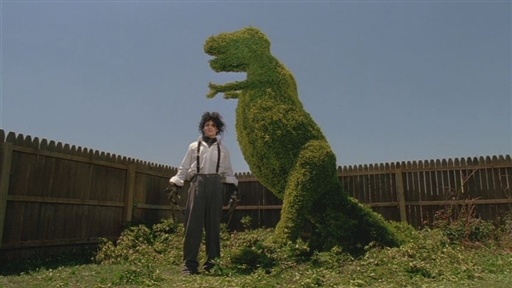
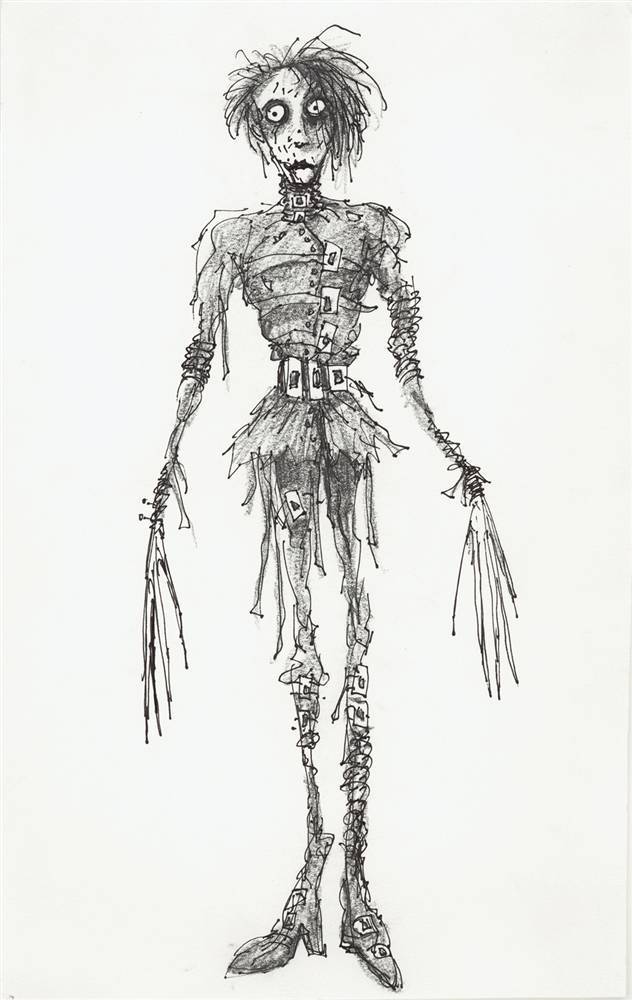
You probably know the story of Edward Scissorhands by now. And if you don't, you at least recognize the unforgettable images or have heard Danny Elfman's equally unforgettable score.  A lonely inventor creates a man but dies before he can finish him, leaving the man with only scissors for hands.  When an innocent Avon lady accidentally discovers him, she brings him home to her small suburban neighborhood, where he becomes very popular among the bored townsfolk.

Johnny Depp makes his Burton debut as the titular Edward Scissorhands.  Known primarily as a teen heartthrob from 21 Jump Street and A Nightmare on Elm Street, Depp curls inward as the shy, misunderstood character. Depp speaks less than 170 words in the entire film and yet his performance is clear and touching.

Dianne Wiest plays Peg, a devoted wife and caring mother, but also a door-to-door makeup salesperson. In many ways, she is similar to Edward. She's optimistic and eternally kind despite being continually downtrodden and disrespected by her neighbors.  She is married to Alan Arkin, who could not be more All-American Dad if he tried.

In any love story, you need a love interest.  Kim, played by Winona Ryder is a girl next door type whose teenage attitude makes her fear Edward and reject him as a freak.  However, she has a good heart and a patient spirit like her mother and finds herself warming to him, much to the annoyance of her boyfriend Jim, played by Brat Pack alum,  Anthony Michael Hall.  He plays a jock who treats Edward like a child and pretends, in his own callous way, to be friends with him.


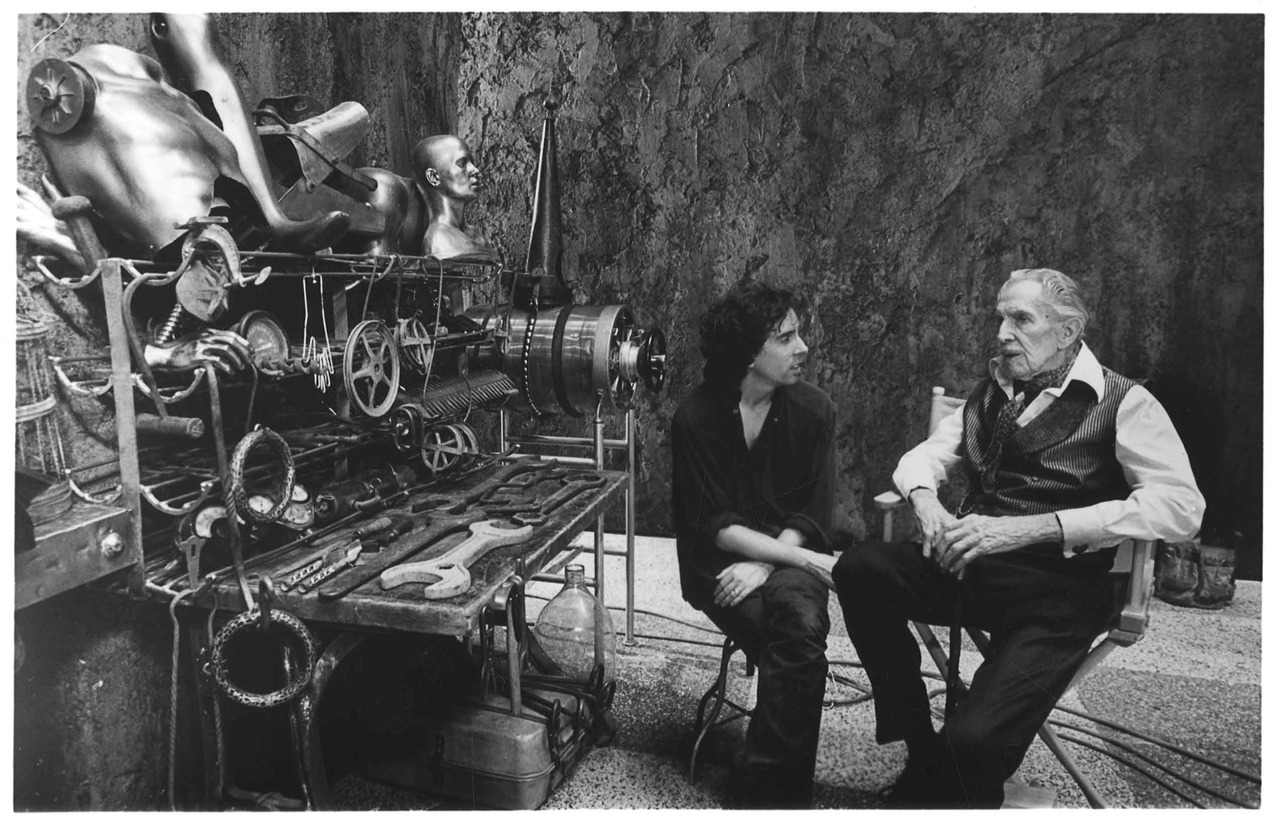
And finally, there is the lonely Inventor played by Vincent Price.  He is inspired to invent Edward while looking at a cookie baking machine of his own creation.  It's that kind of movie.  His role was expanded in the script, but Price was very old, and his battle with emphysema and Parkinson's meant that most of his scenes were cut.  Fittingly, the last scene he shot for the film, that of his death, would be the last thing Price would film in his life.  He passed away shortly thereafter but his role in this movie, however brief, is charming and endearing.

This may be the most Tim Burtony movie of all time.  It is the perfect confluence of his talents.  Once again, his American heritage mixes with his German influences, and while they merged smoothly in Batman, here they clash but they clash beautifully.  Edward Scissorhands exists in a reality slightly skewed from ours.  Peg's pink Avon uniform stands out vibrantly against the gothic castle.  Edward's pale skin and gravity defying hair make him stick out like a sore thumb amongst the clean cut "normal" people that surround him.  His contempt for the American suburbs is fully on display here as well.  The houses are painted in garish Easter pastels and all the men leave for work at exactly the same time, but there is also a scary, dark castle atop a scary, dark mountain that comes out of nowhere.  If it weren't for the fairy tale elements of this movie, one could argue it is riddled with plot holes and marred by dramatic simplicity but it totally works.  If you wonder where Edward gets the blocks of ice, you're asking the wrong questions.


One of the deeper, darker concepts this movie explores is our relationship with phenomena.  Edward is treated with admiration and curiosity but he's nothing more than a novelty to most of the town.  These people are terribly bored.  To them, he is something to gawk at, and when he doesn't behave the way they want him to, he's something to fear.  They are more than happy to believe that he is a thief, a sex offender, and even a murderer despite all evidence to the contrary.  Even Peg, the well-meaning mother, is corrupted by Edward's presence.  As Edward becomes more and more popular, she starts to use him as a means of increasing her social value.

In a deeply troubling scene, Peg sits with Kim and admits that she should never have brought Edward down from that castle.  That their lives would have been better if he had just stayed up there forever.  Its upsetting because even Peg, one of Edward's most passionate defenders, thinks its better for Edward to be locked away in desperately lonely isolation, instead of hoping that others will grow to acknowledge and love him as they do.  Its a dismissal of humanity's worth as a whole.

The only pure person in this movie isn't Edward, its the Inventor, a man who created life out of the emptiness in his heart.  Edward is a child and can be molded as one.  Left to his own devices, he cuts his face.  He hurts everything he touches but longs for human interaction.  His very first lines are "don't go."  He wants to understand the world around him and sees beauty everywhere, but even he is corrupted by the world he is forced to inhabit.  In our culture, he experiences desire and longing, but with it come jealousy and violence.  Edward, it seems, is not meant for this world.


It's impossible to separate the artist from the art in this case.  I'm not referring to Burton's fondness for vibrant colors, black blacks and pale makeup.  I'm referring to Edward as a character and Burton's childhood in Burbank.  At its core, the story is about a lonely young man, who doesn't understand people.  He becomes an artist and even achieves a small level of fame before being chased out of the town he never asked to be a part of.  Edward and Burton even look alike, with the same pale skin and trademark straggly hair.  This only contributes to the film's feeling of honesty.  There is something true about Edward Scissorhands and I think it's because its the most personal movie Tim Burton ever made.

What Burton creates here is a modern day fairy tale; the story of where snow comes from.  The film is intensely moving, thanks in no small part to Depp's performance and Elfman's score.  One scene in particular, in which Winona Ryder asks Edward to hold her always draws a tear from my eye.  Edward Scissorhands is a deeply beautiful, tragic love story that deserves to be seen by everybody. Its just that good.

Wednesday, March 25, 2015

Oeuvre: Mel Brooks - Dracula: Dead and Loving It

After 'The Twilight Saga', everyone seemed in agreement that vampires were overexposed.  A common complaint lobbed at the the series (one of many) was that Edward Cullen and his ilk had nothing in common with vampires, except that they had sharp canines and an occasional thirst for blood.  "Vampires don't sparkle!" they cried.  "You make vampires look silly!"  Poor devils.  If only they'd seen Gary Oldman's hairdo in Francis Ford Coppola's 'Bram Stoker's Dracula' then they'd see how silly a vampire could really look.  Apparently, Brooks thought Oldman looked ridiculous as well for he set out to make his own Dracula parody just shy of the 100th anniversary of Bram Stocker's original novel.  And so, we finish off the films of Mel Brooks with his 1995 box office bomb, 'Dracula: Dead and Loving It.'


The plot closely adheres to most tellings of the Dracula tale.  A solicitor named Thomas Renfield travels to Transylvania to meet with Count Dracula over a real estate deal (no, really).  Dracula reveals himself to be a vampire and hypnotizes Renfield, making him his bitch before traveling to London to... suck some hot bachelorette neck, I guess.

Lets get all the Dracula puns out of the way.  It sucks.  Its lifeless.  It has no teeth.  It's a stake in the heart of Mel Brooks' career.  Bela Lugosee-something-else.  Yada yada yada.  The fact of the matter is that the film isn't very good.  Its more than not very good.  It's terrible.  It's a waste of time.  It's not very appealing to look at.  The cinematography, production design, special effects, and sets look simultaneously expensive and Party City cheap.  For a 90 minute runtime, it feels interminably long and what's worse, its boring.

But the devil is in the details.


Leslie Nielsen plays the titular Dracula.  He is humorous in his effortless Leslie Nielsen way and his comic timing is as impeccable as ever.  He finds a comfortable spot between Bella Legosi, Christopher Lee, and Gary Oldman but despite his decent Bela Lugosi impression, he never creates his own Dracula.  He's just Leslie Nielsen in a Halloween costume.

Peter MacNicol gives Brad Dourif a run for his money as Top Creep.  He starts the film steady as a weak-stomached, extremely British Renfield, but once he falls victim to Dracula's trance he turns into this horrible, screeching mess.  Every minute he was on screen, I wanted to staple my eyes shut.

Amy Yasbeck returns as Mina.  She has worked with Brooks before, plus she is pretty and has a long neck.  However, she has given nothing to do until the last act when she too falls under Dracula's spell.  Her crowning moment is a dance scene between her and Dracula with wirework out of 'Crouching Tiger Hidden Dragon.'

Mel Brooks plays Professor Van Helsing and yup... that's about it.

The only shining light in this film is Steven Weber as Harker, Mina's husband-to-be.  He is the only character who consistently made me smile.  A friend of mine suggested that he may be struggling with a deeply buried homosexuality.  I think he's just fantastically repressed by the times and wants to grab some tit.  His restrained desperation never ceases to be amusing.  He's an oasis in this comedic sahara.

Nielsen stands out in this movie, not because he's particularly good or bad but because he is a legend of parody.  Thanks in no small part to 'Airplane!' and other Zucker Brothers comedies, Nielsen's deadpan delivery and stretchy visage make him instantly recognizable as a satirical icon.  He just doesn't belong in this movie.  He sticks out like a sore thumb and his casting feels like a desperate attempt on Brooks' part for a safe bet.

With 'The Twelve Chairs', Brooks introduced the world to Frank Langella.  Most people don't know this, but Langella played Dracula in 1979.  Why couldn't Brooks bring him back for this, as a knowing wink to the audience?  He was probably busy filming 'Junior.'


This movie is so cheaply made, it's baffling.  In the very beginning of the movie, we see a carriage riding in broad daylight.  Then a shot of the red sunset.  Then a shot of the carriage in broad daylight again.  Its that sort of carelessness that envelopes the film with a lingering scent of "who gives a shit?"  None of the characters have character except for Steven Weber and Leslie Nielsen and even he's just playing himself.  Its impossible to understand what's really going on because nobody has personality, fears, or desires, except "wouldn't it be sad if this woman I told you I loved became a vampire?"  All this could be salvaged if there was a sharp wit to the dialogue but Brooks just replaces the "Your name sounds like something else" jokes from 'Spaceballs' and 'Robin Hood' with the surprisingly less amusing "Aren't accents funny?" jokes.


This is not the worst movie I've ever seen.  Its not even the worst comedy I've seen this year (I'm looking at you, 'Hot Tub Time Machine 2!').  But its really amazing how much work can go into something and the finished product still looks like garbage.  I've always found the process of making comedies fascinating.  Unlike theater or live studio audience sitcoms, you can't tell if something's funny or not until you release it.  You tell a joke on film and nobody can laugh until the director calls "cut!"  I imagine you must feel incredibly stupid jumping around and screaming while dozens of crew members stand stone faced.  And how embarrassed must you be, when the film is released, and all those pin drop quiet, laughless moments are magnified a thousand times?

When 'Dracula: Dead and Loving It' was released, it received universally negative reviews, as well it should.  For a thirty million dollar budget, it only made ten at the box office.  This brought about a firm and decisive end to Mel Brooks directing career.  Not with a bang but with a whimper.

Tuesday, March 24, 2015

Oeuvre: Mel Brooks - Robin Hood: Men in Tights

For the first time in over two decades, Mel Brooks made an original film.  Unfortunately, 'Life Stinks' was a flop in every sense of the word, so, Brooks returned hat in hand to his comfort zone of spoofs with 'Robin Hood: Men in Tights.'


The plot of the story will be familiar to you, even if you haven't seen the Kevin Costner film.  The dashing Robin of Loxley returns from the Crusades to find Rottingham under the tyrannical rule of the corrupt Prince John.  With the help of his Merry Men, Robin Hood must fight to restore order to the kingdom and win the heart of the fair Maid Marian.

Its impossible to ignore the feeling that Brooks is coasting on this one.  There is a constant feeling of "Fine! You like my older parodies?  Well here is exactly what you're expecting!" that never leaves the film.  He's constantly peppering in elements and even direct jokes from his pervious movies.  Prince John's ever-repositioning mole is just a retelling of Igor's hump.  He even exclaims, "I have a mole?!" like how Igor famously asked, "what hump?"  The Sheriff orders Robin Hood to "walk this way!" and they mimic his pompous strut.  The tune for "Men in Tights" is note for note the tune for "Jews in Space."  Mel looks directly at the camera and says, "It's good to be the King."  Dave Chapelle stares down the lens and name-drops Blazing Saddles.  A camera breaks through a glass window after a push in shot like in 'High Anxiety.' And a gaggle of disgruntled peasants scream, "Leave us alone, Mel Brooks!"

Maybe that's the key.  Maybe this is the ultimate parody.  Maybe Brooks isn't just lampooning 'Robin Hood: Prince of Thieves' but his own filmography, challenging the nature of parody, self-referential humor, and the separation of an artist from his content.  Nah, I think he's just lazy.

Brooks receives primary writing credit along with J. D. Shapiro and Evan Chandler.  The former went on to write 'Battlefield Earth' and the latter went on to write nothing else and then died.  You tell me which was the good career move.


And yet, everybody in the cast seems to be aware that the script is less-than-stellar and they counter by throwing themselves into their roles as broadly as possible, working their asses off to wring every drop of comedy they can out of this hot and cold screenplay.

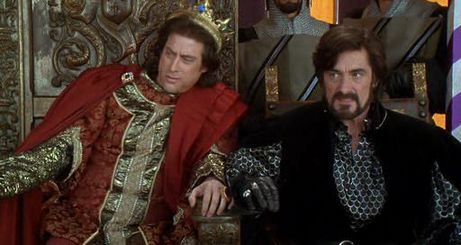
Cary Elwes is Robin Hood and it is perfect casting.  He may be the most charismatic actor to play the part since Errol Flynn.  As 'The Princess Bride' showed, Elwes was born to play dashing, confident swashbucklers.  Unfortunately, Hollywood wasn't making that type of movie anymore, so he's stuck with this.

As Maid Marian, Amy Yasbek is torn between being the respectable maiden society demands and being horny as hell.  Her assistant, Broomhilde played by Megan Cavanagh is a retread of Joan River's character in 'Spaceballs' but with actual character and jokes.

While many play Prince John as a contemptuous, Prince Joffrey-esque prick or sniveling, thumb-sucking coward, Richard Lewis plays the part like the head of a Las Vegas casino.  Its a fresh take that gives his performance a classless texture.

Mark Blankfield gives Mr. Magoo a run for his money as the funniest blind character and Robin Hood's loyal servant.  Mel Brooks cameos as a Rabbi trying to sell the people on circumcisions (a few laughs there), Tracy Ullman is fun as a nasty witch/cook with the hots for the Sheriff.  Oh and Patrick Stewart shows up.

Roger Rees is tasked with playing the pathetically smarmy Sheriff of Rottingham and he commits fully.  There is no fear in this man.  He has the broadest range of emotions, from smug self-satisfaction, to spluttering exasperation, to red-faced fury, to perverted frustration, arousal, and disgust.  He probably comes out of the movie with the most laughs, and for good reason.  He's hilarious.

The real wild card of the bunch is Dave Chapelle in his big screen debut.  I can't tell if he's happy to be in this movie or not but he's definitely done with this Ahchoo joke.  He seems to have a special skill set which is making black jokes and anything outside of it, like a choreographed dance number, makes him visibly uncomfortable.


Its hard not to think of this as a step back for Mel's career after the original film 'Life Stinks' but the movie works more often than it doesn't and it terms of his previous parodies, it far outstrips 'Spaceballs.'  One of the reasons this movie is successful is that the story of Robin Hood lends itself to comedic interpretation far more easily than Star Wars.  The story and those in it have been passed down for centuries and retold dozens and dozens of times, in Errol Flynn's 1938 classic, Disney's 1973 family film, or Ridley Scott's 2010 catastrophe.  Nottingham, Merry Men, "steal from the rich and give to the needy" are all ingrained in cultural history.  Robin Hood is as well known as Darth Vader, but while Rick Moranis had to warp the icon to make him comedic, everyone in Men in Tights simply play heightened versions of their characters.  Lone Starr is just a generic hero but Robin Hood is well-defined by legend and so are his relationships.

In general, the writing is just sharper.  I'll never laugh at Pizza the Hutt.  But for every eye-rolling "your name sounds like another word" joke that Brooks is overly fond of telling, there is one of genuine cleverness.  When Rabbi Tuckman can't convince any of the Merry Men to partake in a ritual circumcision he sighs, "I've got to work on a younger crowd."  And a scene involving a metal glove will never fail to make me laugh.

In an ideal world, Brooks could have skipped all of his films in between and just made this right after 'Young Frankenstein.'  Its obviously a parody but it almost works as its own retelling of the Robin Hood myth.  Then he could have made 'Life Stinks' and moved on to wholly original films.  Alas.  Men in Tights has a cult following now but it was only a moderate success at the time.  Brooks thought a parody of Robin Hood was a safe bet, but the age of his particular brand of parody was coming to a close.  The noose was tightening and his next and final film was the nail in the coffin.

Oeuvre: Mel Brooks - Life Stinks


After almost a quarter of a century making parody after parody, Brooks attempted something truly revolutionary; an original idea.
Life Stinks Movie Poster
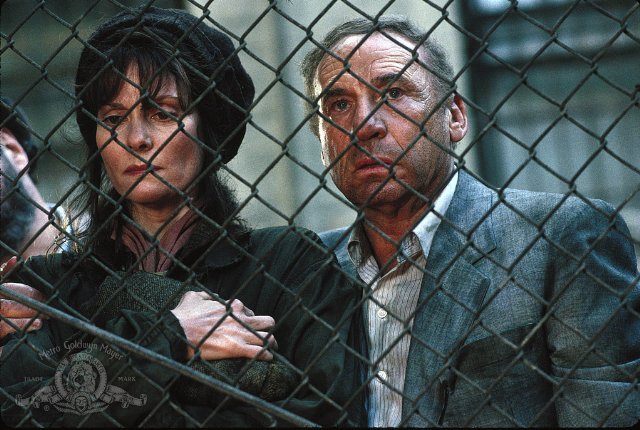
Life Stinks is the story and eventual mantra of coldhearted CEO, Goddard Bolt,  a man with nothing but contempt for anyone whose net worth is less than seven figures.  His greatest ambition is to tear down a crummy neighborhood and build a monument to his own hubris.  Unfortunately, that land is owned by a business rival who agrees to sell the property for next to nothing if Bolt can survive one month on said streets.  A wager is struck, hands are shaken, and the countdown begins.

Immediately, Brooks realizes that being homeless is a daily struggle, one which he is not capable of confronting.  He loses his hairpiece and mustache, his suit is torn, and he spends the first night sleeping amongst the rats.  Out of desperation, he befriends a colorful cast of kind, well-meaning bums with Dickensian names like Sailor, played with innocent charm by Howard Morris and his watchful protector, Fumes, played by Theodore Wilson.  They christen him "Pepto" after the Pepto-Bismol box in which Bolt spends his first night.

There comes a point in every filmmaker's life where they attempt a Frank Capra story.  Frank Darabont had 'The Majestic' and Steven Spielberg had 'The Terminal.'  One thing that all these stories have in common is a lack of any anger or sarcasm and most importantly, open sincerity and sentimentality.  Brooks is walking down a familiar trail here but for the most part, he rarely stumbles.

Brooks is surprisingly solid as Bolt.  He's so clueless without his money that he doesn't even think about soup kitchens and he really sells the desperation.  Lesley Ann Warren, as exceptional as she is underrated, plays Molly, a Broadway dancer with a tragic past.  She plays the part with tremendous bite and when she tells Brooks what happened to her, your heart will break.

Easily my favorite part of the movie is the perpetually pouty Jeffrey Tambor as Vance Crasswell, Bolt's sincerely insincere competitor who walks into every room like he's interrupting something important and isn't sure if he should leave or not.

One of the issues this movie faces is that its stylistically inconsistent.  We start off with a strong, visually amusing beginning that reminds me of 'The Hudsucker Proxy' by the Coen Brothers.  However, that heightened atmosphere is abandoned once Bolt winds up on the streets.  The problem is that, while the slums are a fantasy of what homeless life is like, its only a slight fantasy.  As a result, the two worlds, and Goddard Bolt's entire character arc don't gel.  The whole last act needs to be rewritten too.  It feels like Brooks didn't know how to resolve the story and since he has followed convention at every turn up to this point, he went with the most obvious choices for a finale.  He pursues a go-big-or-go-home ending when the story felt so much more intimate than that.  This leads to a climax that is clumsy, contrived, and ineffective.


That said, this movie has a good heart at its center.  Brooks is really stretching himself here both as an actor and a filmmaker as a whole.  Its not a strong film but it shows growth and maturity.  The way Annie Hall showed confidence in Allen's storytelling ability, Brooks is trying to tell a true story where the jokes come from the characters and not movie references.  Its clear that Brooks has something to say here, possibly out of the guilt that comes with being successful in LA where the dichotomy between the rich and poor is extreme.  He attacks the one percent, lawyers, hospital workers, and most importantly, the viewer, for how we turn away and do nothing.

Life Stinks is constantly referred to as one of Brooks' weakest films.  I honestly don't know why.  I've seen Brooks' worst and we'll get to that momentarily.  The transition from the first act to the inciting incident is jarring and the last act needs to change completely but the middle hits a consistent stride that Brooks has never had the courage to try before.  Its not a great film but it is by no means a bad one.  I assume one of the reason Brooks fans don't like this movie is the same reason I think that its so interesting.  Its original.

Sadly, the film was a both a critical and financial flop and so, Brooks returned to his comfort zone, but one can't help but wonder, if this story were a little tighter, the writing a little sharper, and the reviews a little more positive, what might have been.