Showing posts with label Mel Brooks. Show all posts

Wednesday, March 25, 2015

Oeuvre: Mel Brooks Retrospective

As I said in my first review, the Oeuvre project was just something that I started with a friend to keep in touch, as well as keeping our critical minds sharp, and to give us a chance to explore and revisit films we might never have watched otherwise.  

For the past month and a half or so, I've been watching and reviewing the films of Mel Brooks.  I had heard of almost all of his work but I had never seen most of them and exploring unknown decades of his career was intriguing.


Its always interesting to watch a director change over time.  Whether they evolve or stagnate.  As long as I've known about Mel Brooks, I've known him as a comic legend.  The common man equivalent to Woody Allen.  There was even a debate over which of these New York Jewish comedians was "better" on 'Siskel and Ebert.'  (http://siskelandebert.org/video/8R52X9UUUHXO/Sneak-Previews--Mel-Brooks-or-Woody-Allen-1980)

Is that reputation justified?  Somewhat.  Do I think he's worthy of his iconic status?  Sort of.  After watching all of his films, I can definitively say, he's more visual than Allen.  In fact, his visual flair may be Brooks' greatest asset.  He's not a auteur but he has an eye for the sight gag and his passion for meta humor must have been revolutionary.  He had a talent for surrounding himself with and reusing talented performers such as Gene Wilder, Madeline Kahn, Cloris Leachman, Harvey Korman, Marty Feldman, and Dom DeLuise.  These casting favorites, along with a long career as a parodist gave Brooks a brand he would live by for the rest of his career.  I don't think he integrated himself as a star of his own films as successfully as Allen, in fact I think it was often a detriment to his material.  Perhaps his films would have been stronger with someone else in front of the camera.  And unfortunately, that self-imposed label as a parodist would haunt him.  I firmly believe that the only reason 'Life Stinks' is treated with such vehement disregard is because it is such a radical departure for him. 

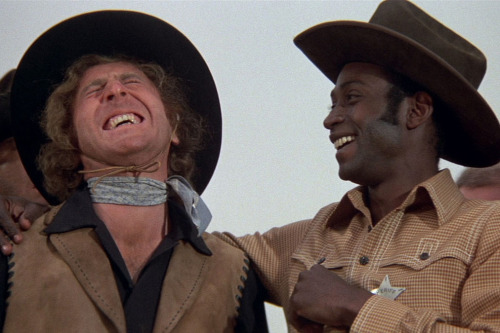
When I think of Mel Brooks at his best, I think of self-referential comedy, broad slapstick, gross-out jokes, social commentary, and a love of the absurd.  Of all his films, I think 'Blazing Saddles' is the one that best encapsulates his career.  It deftly blends satire of the Western genre with an undercurrent of racisms and general prejudice.  Its climax is the most self-aware Mel Brooks has ever gotten without tripping over himself, and the screenplay sparkles with line after line of quotable material.


Its hard to watch his career from beginning to end without thinking about his influence but also about how time seemed to pass him by.  While he was making 'High Anxiety', the Zucker Brothers were about to hit it big with the absurdist parody 'Airplane!'  A year after he retired with 'Dracula: Dead and Loving It', Wes Craven released one of my favorite horror/self-aware comedies, 'Scream' and only a few years after that, Keenen Wayans released 'Scary Movie' which itself felt like a Brooks style parody of Scream.  We reached a whirlpool of parody circling parody, a snake eating its own tale.  I can't help but think of Brooks as one of the grandfathers of that style of comedy.

Brooks had a legendary rise to stardom as a comedic filmmaker with The Producers, winning best original screenplay for his first film.  How many can claim that?  Diablo Cody is the only name that comes to mind.  Though his star dwindled and faded away with flops towards the end, its clear how numerous films of his wind up on multiple Greatest Comedies of All Time lists.

For good or ill, hilarious or mind-numbingly terrible, his films were consistently his.  And that's one of the greatest compliments I can pay any director.

***

Up Next!

Oeuvre: Mel Brooks - Dracula: Dead and Loving It

After 'The Twilight Saga', everyone seemed in agreement that vampires were overexposed.  A common complaint lobbed at the the series (one of many) was that Edward Cullen and his ilk had nothing in common with vampires, except that they had sharp canines and an occasional thirst for blood.  "Vampires don't sparkle!" they cried.  "You make vampires look silly!"  Poor devils.  If only they'd seen Gary Oldman's hairdo in Francis Ford Coppola's 'Bram Stoker's Dracula' then they'd see how silly a vampire could really look.  Apparently, Brooks thought Oldman looked ridiculous as well for he set out to make his own Dracula parody just shy of the 100th anniversary of Bram Stocker's original novel.  And so, we finish off the films of Mel Brooks with his 1995 box office bomb, 'Dracula: Dead and Loving It.'


The plot closely adheres to most tellings of the Dracula tale.  A solicitor named Thomas Renfield travels to Transylvania to meet with Count Dracula over a real estate deal (no, really).  Dracula reveals himself to be a vampire and hypnotizes Renfield, making him his bitch before traveling to London to... suck some hot bachelorette neck, I guess.

Lets get all the Dracula puns out of the way.  It sucks.  Its lifeless.  It has no teeth.  It's a stake in the heart of Mel Brooks' career.  Bela Lugosee-something-else.  Yada yada yada.  The fact of the matter is that the film isn't very good.  Its more than not very good.  It's terrible.  It's a waste of time.  It's not very appealing to look at.  The cinematography, production design, special effects, and sets look simultaneously expensive and Party City cheap.  For a 90 minute runtime, it feels interminably long and what's worse, its boring.

But the devil is in the details.


Leslie Nielsen plays the titular Dracula.  He is humorous in his effortless Leslie Nielsen way and his comic timing is as impeccable as ever.  He finds a comfortable spot between Bella Legosi, Christopher Lee, and Gary Oldman but despite his decent Bela Lugosi impression, he never creates his own Dracula.  He's just Leslie Nielsen in a Halloween costume.

Peter MacNicol gives Brad Dourif a run for his money as Top Creep.  He starts the film steady as a weak-stomached, extremely British Renfield, but once he falls victim to Dracula's trance he turns into this horrible, screeching mess.  Every minute he was on screen, I wanted to staple my eyes shut.

Amy Yasbeck returns as Mina.  She has worked with Brooks before, plus she is pretty and has a long neck.  However, she has given nothing to do until the last act when she too falls under Dracula's spell.  Her crowning moment is a dance scene between her and Dracula with wirework out of 'Crouching Tiger Hidden Dragon.'

Mel Brooks plays Professor Van Helsing and yup... that's about it.

The only shining light in this film is Steven Weber as Harker, Mina's husband-to-be.  He is the only character who consistently made me smile.  A friend of mine suggested that he may be struggling with a deeply buried homosexuality.  I think he's just fantastically repressed by the times and wants to grab some tit.  His restrained desperation never ceases to be amusing.  He's an oasis in this comedic sahara.

Nielsen stands out in this movie, not because he's particularly good or bad but because he is a legend of parody.  Thanks in no small part to 'Airplane!' and other Zucker Brothers comedies, Nielsen's deadpan delivery and stretchy visage make him instantly recognizable as a satirical icon.  He just doesn't belong in this movie.  He sticks out like a sore thumb and his casting feels like a desperate attempt on Brooks' part for a safe bet.

With 'The Twelve Chairs', Brooks introduced the world to Frank Langella.  Most people don't know this, but Langella played Dracula in 1979.  Why couldn't Brooks bring him back for this, as a knowing wink to the audience?  He was probably busy filming 'Junior.'


This movie is so cheaply made, it's baffling.  In the very beginning of the movie, we see a carriage riding in broad daylight.  Then a shot of the red sunset.  Then a shot of the carriage in broad daylight again.  Its that sort of carelessness that envelopes the film with a lingering scent of "who gives a shit?"  None of the characters have character except for Steven Weber and Leslie Nielsen and even he's just playing himself.  Its impossible to understand what's really going on because nobody has personality, fears, or desires, except "wouldn't it be sad if this woman I told you I loved became a vampire?"  All this could be salvaged if there was a sharp wit to the dialogue but Brooks just replaces the "Your name sounds like something else" jokes from 'Spaceballs' and 'Robin Hood' with the surprisingly less amusing "Aren't accents funny?" jokes.


This is not the worst movie I've ever seen.  Its not even the worst comedy I've seen this year (I'm looking at you, 'Hot Tub Time Machine 2!').  But its really amazing how much work can go into something and the finished product still looks like garbage.  I've always found the process of making comedies fascinating.  Unlike theater or live studio audience sitcoms, you can't tell if something's funny or not until you release it.  You tell a joke on film and nobody can laugh until the director calls "cut!"  I imagine you must feel incredibly stupid jumping around and screaming while dozens of crew members stand stone faced.  And how embarrassed must you be, when the film is released, and all those pin drop quiet, laughless moments are magnified a thousand times?

When 'Dracula: Dead and Loving It' was released, it received universally negative reviews, as well it should.  For a thirty million dollar budget, it only made ten at the box office.  This brought about a firm and decisive end to Mel Brooks directing career.  Not with a bang but with a whimper.

Tuesday, March 24, 2015

Oeuvre: Mel Brooks - Robin Hood: Men in Tights

For the first time in over two decades, Mel Brooks made an original film.  Unfortunately, 'Life Stinks' was a flop in every sense of the word, so, Brooks returned hat in hand to his comfort zone of spoofs with 'Robin Hood: Men in Tights.'


The plot of the story will be familiar to you, even if you haven't seen the Kevin Costner film.  The dashing Robin of Loxley returns from the Crusades to find Rottingham under the tyrannical rule of the corrupt Prince John.  With the help of his Merry Men, Robin Hood must fight to restore order to the kingdom and win the heart of the fair Maid Marian.

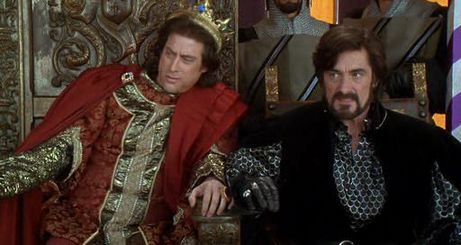
Its impossible to ignore the feeling that Brooks is coasting on this one.  There is a constant feeling of "Fine! You like my older parodies?  Well here is exactly what you're expecting!" that never leaves the film.  He's constantly peppering in elements and even direct jokes from his pervious movies.  Prince John's ever-repositioning mole is just a retelling of Igor's hump.  He even exclaims, "I have a mole?!" like how Igor famously asked, "what hump?"  The Sheriff orders Robin Hood to "walk this way!" and they mimic his pompous strut.  The tune for "Men in Tights" is note for note the tune for "Jews in Space."  Mel looks directly at the camera and says, "It's good to be the King."  Dave Chapelle stares down the lens and name-drops Blazing Saddles.  A camera breaks through a glass window after a push in shot like in 'High Anxiety.' And a gaggle of disgruntled peasants scream, "Leave us alone, Mel Brooks!"

Maybe that's the key.  Maybe this is the ultimate parody.  Maybe Brooks isn't just lampooning 'Robin Hood: Prince of Thieves' but his own filmography, challenging the nature of parody, self-referential humor, and the separation of an artist from his content.  Nah, I think he's just lazy.

Brooks receives primary writing credit along with J. D. Shapiro and Evan Chandler.  The former went on to write 'Battlefield Earth' and the latter went on to write nothing else and then died.  You tell me which was the good career move.


And yet, everybody in the cast seems to be aware that the script is less-than-stellar and they counter by throwing themselves into their roles as broadly as possible, working their asses off to wring every drop of comedy they can out of this hot and cold screenplay.

Cary Elwes is Robin Hood and it is perfect casting.  He may be the most charismatic actor to play the part since Errol Flynn.  As 'The Princess Bride' showed, Elwes was born to play dashing, confident swashbucklers.  Unfortunately, Hollywood wasn't making that type of movie anymore, so he's stuck with this.

As Maid Marian, Amy Yasbek is torn between being the respectable maiden society demands and being horny as hell.  Her assistant, Broomhilde played by Megan Cavanagh is a retread of Joan River's character in 'Spaceballs' but with actual character and jokes.

While many play Prince John as a contemptuous, Prince Joffrey-esque prick or sniveling, thumb-sucking coward, Richard Lewis plays the part like the head of a Las Vegas casino.  Its a fresh take that gives his performance a classless texture.

Mark Blankfield gives Mr. Magoo a run for his money as the funniest blind character and Robin Hood's loyal servant.  Mel Brooks cameos as a Rabbi trying to sell the people on circumcisions (a few laughs there), Tracy Ullman is fun as a nasty witch/cook with the hots for the Sheriff.  Oh and Patrick Stewart shows up.

Roger Rees is tasked with playing the pathetically smarmy Sheriff of Rottingham and he commits fully.  There is no fear in this man.  He has the broadest range of emotions, from smug self-satisfaction, to spluttering exasperation, to red-faced fury, to perverted frustration, arousal, and disgust.  He probably comes out of the movie with the most laughs, and for good reason.  He's hilarious.

The real wild card of the bunch is Dave Chapelle in his big screen debut.  I can't tell if he's happy to be in this movie or not but he's definitely done with this Ahchoo joke.  He seems to have a special skill set which is making black jokes and anything outside of it, like a choreographed dance number, makes him visibly uncomfortable.


Its hard not to think of this as a step back for Mel's career after the original film 'Life Stinks' but the movie works more often than it doesn't and it terms of his previous parodies, it far outstrips 'Spaceballs.'  One of the reasons this movie is successful is that the story of Robin Hood lends itself to comedic interpretation far more easily than Star Wars.  The story and those in it have been passed down for centuries and retold dozens and dozens of times, in Errol Flynn's 1938 classic, Disney's 1973 family film, or Ridley Scott's 2010 catastrophe.  Nottingham, Merry Men, "steal from the rich and give to the needy" are all ingrained in cultural history.  Robin Hood is as well known as Darth Vader, but while Rick Moranis had to warp the icon to make him comedic, everyone in Men in Tights simply play heightened versions of their characters.  Lone Starr is just a generic hero but Robin Hood is well-defined by legend and so are his relationships.

In general, the writing is just sharper.  I'll never laugh at Pizza the Hutt.  But for every eye-rolling "your name sounds like another word" joke that Brooks is overly fond of telling, there is one of genuine cleverness.  When Rabbi Tuckman can't convince any of the Merry Men to partake in a ritual circumcision he sighs, "I've got to work on a younger crowd."  And a scene involving a metal glove will never fail to make me laugh.

In an ideal world, Brooks could have skipped all of his films in between and just made this right after 'Young Frankenstein.'  Its obviously a parody but it almost works as its own retelling of the Robin Hood myth.  Then he could have made 'Life Stinks' and moved on to wholly original films.  Alas.  Men in Tights has a cult following now but it was only a moderate success at the time.  Brooks thought a parody of Robin Hood was a safe bet, but the age of his particular brand of parody was coming to a close.  The noose was tightening and his next and final film was the nail in the coffin.

Oeuvre: Mel Brooks - Life Stinks


After almost a quarter of a century making parody after parody, Brooks attempted something truly revolutionary; an original idea.
Life Stinks Movie Poster
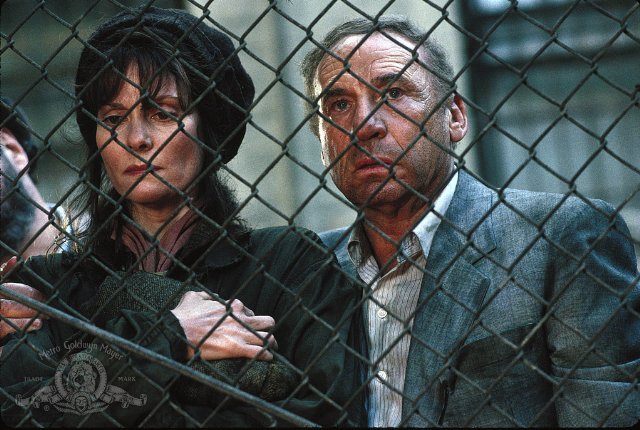
Life Stinks is the story and eventual mantra of coldhearted CEO, Goddard Bolt,  a man with nothing but contempt for anyone whose net worth is less than seven figures.  His greatest ambition is to tear down a crummy neighborhood and build a monument to his own hubris.  Unfortunately, that land is owned by a business rival who agrees to sell the property for next to nothing if Bolt can survive one month on said streets.  A wager is struck, hands are shaken, and the countdown begins.

Immediately, Brooks realizes that being homeless is a daily struggle, one which he is not capable of confronting.  He loses his hairpiece and mustache, his suit is torn, and he spends the first night sleeping amongst the rats.  Out of desperation, he befriends a colorful cast of kind, well-meaning bums with Dickensian names like Sailor, played with innocent charm by Howard Morris and his watchful protector, Fumes, played by Theodore Wilson.  They christen him "Pepto" after the Pepto-Bismol box in which Bolt spends his first night.

There comes a point in every filmmaker's life where they attempt a Frank Capra story.  Frank Darabont had 'The Majestic' and Steven Spielberg had 'The Terminal.'  One thing that all these stories have in common is a lack of any anger or sarcasm and most importantly, open sincerity and sentimentality.  Brooks is walking down a familiar trail here but for the most part, he rarely stumbles.

Brooks is surprisingly solid as Bolt.  He's so clueless without his money that he doesn't even think about soup kitchens and he really sells the desperation.  Lesley Ann Warren, as exceptional as she is underrated, plays Molly, a Broadway dancer with a tragic past.  She plays the part with tremendous bite and when she tells Brooks what happened to her, your heart will break.

Easily my favorite part of the movie is the perpetually pouty Jeffrey Tambor as Vance Crasswell, Bolt's sincerely insincere competitor who walks into every room like he's interrupting something important and isn't sure if he should leave or not.

One of the issues this movie faces is that its stylistically inconsistent.  We start off with a strong, visually amusing beginning that reminds me of 'The Hudsucker Proxy' by the Coen Brothers.  However, that heightened atmosphere is abandoned once Bolt winds up on the streets.  The problem is that, while the slums are a fantasy of what homeless life is like, its only a slight fantasy.  As a result, the two worlds, and Goddard Bolt's entire character arc don't gel.  The whole last act needs to be rewritten too.  It feels like Brooks didn't know how to resolve the story and since he has followed convention at every turn up to this point, he went with the most obvious choices for a finale.  He pursues a go-big-or-go-home ending when the story felt so much more intimate than that.  This leads to a climax that is clumsy, contrived, and ineffective.


That said, this movie has a good heart at its center.  Brooks is really stretching himself here both as an actor and a filmmaker as a whole.  Its not a strong film but it shows growth and maturity.  The way Annie Hall showed confidence in Allen's storytelling ability, Brooks is trying to tell a true story where the jokes come from the characters and not movie references.  Its clear that Brooks has something to say here, possibly out of the guilt that comes with being successful in LA where the dichotomy between the rich and poor is extreme.  He attacks the one percent, lawyers, hospital workers, and most importantly, the viewer, for how we turn away and do nothing.

Life Stinks is constantly referred to as one of Brooks' weakest films.  I honestly don't know why.  I've seen Brooks' worst and we'll get to that momentarily.  The transition from the first act to the inciting incident is jarring and the last act needs to change completely but the middle hits a consistent stride that Brooks has never had the courage to try before.  Its not a great film but it is by no means a bad one.  I assume one of the reason Brooks fans don't like this movie is the same reason I think that its so interesting.  Its original.

Sadly, the film was a both a critical and financial flop and so, Brooks returned to his comfort zone, but one can't help but wonder, if this story were a little tighter, the writing a little sharper, and the reviews a little more positive, what might have been.

Wednesday, March 11, 2015

Oeuvre: Mel Brooks - Spaceballs


Brooks has satirized westerns, silent films, horror films, Hitchcock thrillers, and period piece epics.  Each genre as important to film history as the other.  But in 1987, Brooks took aim at the film that revolutionized entertainment and changed the way films were made, and indeed marketed, forever.  STAR WARS.


The story is awfully familiar.  Lone Starr, a rebellious space pirate and his loyal companion, Barf, attempt to rescue the beautiful Princess Vespa as President Skroob, Colonel Sandurz, and the evil Dark Helmet threaten to destroy the peaceful planet of Druidia.

Bill Pullman is charming Lone Starr, a dashing rogue with a mysterious past.  He and Candy have legitimately good chemistry and the two would make a good team in a better movie.  Looking at him, you think, "I would vote for that man if he ran for President."

Daphne Zuniga plays Princess Vespa.  She's very attractive and willing which is all the part required. She is constantly pursued, though never aided by her servant, a trashy golden robot named Dot Matrix, voiced by the late Joan Rivers.  I constantly felt bad for Joan.  Her character doesn't do anything and I can't imagine Joan found any of these jokes funny.  She's forced to deliver lines like, "I couldn't hold my oil."

The two shining stars of this galactic farce are John Candy as Barf (hear me out) and Rick Moranis as Dark Helmet.  Both are playing to type but they embrace it so thoroughly, its hard not to laugh.  Candy plays Lone Starr's co-pilot, a Mog (half man, half dog, his own best friend) and his cowardly sincerity, wagging tail, and perky ears go a long way.  But the real winner in this picture is Dark Helmet and the inspired casting of Rick Moranis.  Moranis made a career out of playing lovable losers.  Here he is appropriately, hilariously dweeby and pathetic.  Making "Darth Vader has asthma" jokes is nothing new but this is the first time it felt earned.  He squeezes every drop of comedy out of the character.

Brooks plays two roles.  His scenes as the malevolent President Skroob are often funny.  His scenes as Master Yogurt (get it?) are not.


Unlike Brooks' more successful parodies, Blazing Saddles and Young Frankenstein, the social commentary and the plot don't ever move hand in hand.  The merchandising of Star Wars, as inescapable now as it was 40 years ago, never effectively synchronizes with the plot.  The result is a comedy that stops for jokes and a plot that doesn't mean anything.

This is a really strange film for Brooks, not because there isn't comedic fruit, people have been making fun of these movies for decades, but because while Blazing Saddles made fun of westerns, High Anxiety made fun of Alfred Hitchcock's filmography, and History of the World made fun of period piece epics, Spaceballs is making fun of one film specifically.  Its even more specific than Young Frankenstein.  The film doesn't so much reference or poke fun at other science fiction films or tropes as it does mention them directly ("Why not?  It worked in Star Trek.").  This could have been a parody of how films tried to copy the Star Wars formula with diminishing returns.  Instead, it becomes one of them.

Long gone are the days of The Producers when Brooks would write a cohesive story.  Spaceballs is so rigidly tied to Star Wars' structure that it is incapable of breathing.  Its hampered by a spine that wasn't meant to be funny, and in the few moments it breaks away from that skeleton, like when Dark Helmet fulfills his deepest fantasies with action figures, it suddenly snaps back into its unfunny plot.  The Producers set out to find a play so horrible that it would be a surefire flop.  Blazing Saddles put a black sheriff in charge of a racist town.  Notice something similar?  Both plots contain comedic conflict.  And here is Spaceballs' plot synopsis according to IMDB, "Planet Spaceball's President Skroob sends Lord Dark Helmet to steal Planet Druidia's abundant supply of air to replenish their own, and only Lone Starr can stop them."  Where is the comedy in that?  From the names, I guess.

This movie may be the definition of "it was funny at the time" humor.  In the first 10 minutes, we already have two bumper sticker jokes.  Jabba the Hutt is replaced by Pizza the Hutt and its the only time Brooks outdoes Lucas.  Jabba is a fat slug but Pizza the Hutt is flat out revolting.  Now if only the gag made us laugh instead of... gag.  But then there are things that are dated or just plain boring to begin with.  Michael Winslow, the funny noise guy from Police Academy, remember him?  Yeah, he's here to do the same schtick.  The only people to do something original with that premise were Key and Peele.  But then there's jokes about matching luggage, industrial strength hair dryers, and robotic henchmen who talk like 20s New York gangsters and wear zoot suits.  The Millennium Falcon is replaced with a Winnebago and in the climax, the bad guys' ship turns into a giant robotic cleaning lady with a vacuum.  It sucks.

And don't get me started on Yogurt and the Schwartz.  Is this a Schwarzenegger joke?  Is it a jewish sounding word?  I don't know but what's worse, I ain't laughin.


That being said, there were things I really enjoyed about the movie.  As previously mentioned, Lone Starr and Barf (just keeps getting funnier, Mel) have great chemistry.  They make a good team and I would have liked to see them together in something not Han and Chewbacca related.  A weak scene involving Star Trek beaming and butt displacement has a hilarious, laugh out loud payoff.  And there was also one scene that really, honest to God, impressed me.  There is a scene by campfire on the desert planet of Not-Tattooine-Really-Please-Don't-Sue, where Lone Starr and Princess Vespa discuss their pasts.  She is to marry a prince she doesn't love but considers sacrifice part of her duties as a princess.  Lone Starr flirts by telling her that physical contact isn't all its cracked up to be.  Its a genuine scene and it genuinely works.

One of the defining traits of Mel Brooks' career has been his passion for meta comedy.  He has implemented it as an unexpected finale of 'Blazing Saddles' and he has used it as a crutch when he couldn't think of an ending for 'History of the World.'  Now Brooks embraces the insanity and brandishes the absurdity with a bold confidence.  Star Wars is, after all, the film that practically defined merchandising.  I would go so far as to wager that it was the Spaceballs merchandising joke alone that inspired Brooks to make this entire film.  Around half way through the movie, the hapless villains are at a loss for what to do.  "We'll consult the videotape!" declares Colonel Sandurz.  They open up their VHS collection, containing all of Brooks' previous filmography, and pop in Spaceballs.  They fast forward, black and white squiggles covering what we've already seen in a way that only those of the VHS generation will remember.  Then they reach where we are now.  Dark Helmet and Sandurz see themselves in real time.  The movie is watching itself.    This is it, guys, the singularity.  The only way to go further will be for the movie to show us the ending at the middle and be done with it.


Only one aspect of this movie really interested me on an intellectual level.  With so many shots of people shouting out "the Schwartz!" in awe, it did make me chuckle thinking about how stupid Mark Hamill, Harrison Ford, Carrie Fischer, and Alec Guinness must have felt, talking about nonsense like "Jedi Knights" and "the Force."  What the hell is a Jedi anyway?  The only difference is that Star Wars has a shelf life of forever and Spaceball has a shelf life of about 15 minutes.

This film has one major problem that I jut can't overlook and that is that it is very negative and mean-spirited towards the subject matter.  I know that I can't be impartial.  My love for Star Wars goes back longer than I can remember.  But I couldn't shake the feeling that Brooks really doesn't like Star Wars and that, in the end, he just thinks its stupid.  Try as he might, he's always under Star Wars' shadow.  Go watch Family Guy's "Blue Harvest" if you want to see a Star Wars parody done right.  Not every joke lands, but most of them do and there's love in the work.  Brooks comes across as resentful and bitter at what Star Wars has done to the world.  But his movie doesn't exist on its own.  Its not a glaring take-down or even a chink the the armor.  Its a crass, ugly film that tries to be funny and occasionally succeeds but never lets us forget, with every bit of gross-out humor, and every lightsaber dick joke, and every empty second devoid of laughter, that we could be watching an infinitely better film.

Monday, March 9, 2015

Oeuvre: Mel Brooks - History of the World. Part I

It's good to be the King.  Not so great to be an audience member.


'History of the World. Part I' is an uneven, overlong, tired comedy of clichés and jokes as old as the time periods it lampoons.

Essentially, Brooks is satirizing epic period pieces, breaking this film into 5 chapters; the Stone Age/Dawn of Man, the Old Testament, the Roman Empire, the Spanish Inquisition, and the French Revolution.

We begin with an homage to Stanley Kubrick's '2001: A Space Odyssey' and masturbating apes, laying to rest my suspicions that this was indeed going to be a long 92 minutes.  Both the Cavemen and the world they inhabit look like instillations at the American Museum of Natural History.  There is one clever joke in the entire segment, one, in which we see a Caveman painting and creating art for the first time.  "With the birth of the artist came the inevitable afterbirth... the critic."  Then Mel goes and ruins a perfectly good joke by having another Caveman piss on the wall.  I check my watch.

The Old Testament has a famous joke about there being 15 Amendments until Moses dropped one.

The Roman Empire contains the lion's share of the screen time, roughly 41 minutes.  It tells the story of a stand-up philosopher, a slave, and a virgin who desperately want to flee Rome.  Lots of adding 'us' to the end of names.

The Spanish Inquisition is essentially one eight minute Las Vegas style musical number.  Its as hit and miss as it sounds.

The movie actually picks up steam with the French Revolution segment, where it takes on a Prince and the Pauper type romp.  Of all the segments, this one feels like it could be its own movie and its a shame that Brooks didn't cut the rest and focus on this story entirely.  The sever dichotomy between the poor and the wealthy alone is ripe for comedy.  Brooks is at his disgusting best as the King, forcing a woman to sleep with him to free her father from prison.  Unfortunately, Brooks has little interest in the plight of the peasants and the story rushes to and messy climax before pulling the rug out from under us in an ending so lazy and maddening that it soured the entire movie for me.  Alas.


Mel Brooks plays Moses, Torquemada, Jacques, and King Louis XVI but his most substantial role is Comicus, a stand-up philosopher who isn't as funny as Mel Brooks thinks he is.  He should be playing Narcissus.

Gregory Hines plays Josephus, a slave who can dance and call people "Honkus."

Dom DeLuise continues to play fat people who used to have more characteristics but they ate them all.  History calls him Emperor Nero.

Madeline Kahn plays Nympho, a character who speaks entirely in lame double entendres while Mel Brooks strokes himself off camera.

Harvey Korman appears in the last sketch as Count de Money.  The big (only) joke here is that people keep calling him Money, a callback to Korman's Hedley Lamar in 'Blazing Saddles.'  A real knee-slapper (sarcasm).  A slightly more highbrow joke would be for people to keep calling him Manet, but class has never been in Brooks' wheelhouse.  Besides, we have more piss jokes to tell.

Chloris Leachman plays Madame Defarge, whom the more well-read will know as a revolutionary in Charles Dickens' 'A Tale of Two Cities.'  She has little to do and Brooks is merciful by not making a Madame Defart joke.  The audience breaths a sigh of relief.

The film also contains the biggest waste of Orson Welles since the infamous Paul Masson commercial but with far fewer laughs.

Far more talented actors only get one role while Brooks gets five.  Why not bring everyone back and make this the Cloud Atlas of comedy?  Madeline Kahn is a talented comedian and is constantly underused.  Why not have her play multiple roles?  Because Mel Brooks would get tired of kissing the same pair of tits.  That's why.


Almost every scene in this movie is a clunker.  Brooks seems to know this, and for the most part, keeps every scene down to three minutes.  He never tries to establish a cohesive through-line or purpose to these set pieces.  There is no rhyme or reason to their length.  Each "story", and ultimately the movie itself, only lives as long as Mel Brooks can think of jokes to pile on to this weary skeleton.  He could only come up with 10 jokes for the Spanish Inquisition so its only 8 minutes.  He thought there were loads of jokes he could write about Rome.  So its five times as long.

This is a comedy of labels rather than ideas.  Brooks seems to think that shouting "GAYS!" or "JEWS!" is funny.  People are not inherently funny.  They are the baseline of a joke.  "An alcoholic, a priest, and a child molester walk into a bar" is not a joke.  It is a setup.  "An alcoholic, a priest, and a child molester walk into a bar... and that's just the first guy."  THAT'S a joke.  At one point during the Spanish Inquisition, Torquemada cries, "we've flattened their fingers, we've branded their buns, nothing is working... send in the nuns!"  At that point, a line of nuns march out, remove their coifs and gowns and diving into a pool for a synchronized swimming routine, where they do nothing religious and cease to be nuns entirely.  So why have them be nuns in the first place?  Because nuns are funny to look at?  Because "nun" is a funny word to say?  Nothing is working, indeed.

I feel like a teacher lecturing the class clown.  Mel, you're coasting on passing grades and the odd chuckle.  I know you can be better than this.  I just wish you'd try harder.  For the rest of you, go see what Monty Python is doing with 'Life of Brian' and 'Monty Python and the Holy Grail.'  Now that's an A student.

Friday, March 6, 2015

The Director's Oeuvre: Mel Brooks - High Anxiety

1977 was a watershed year for filmmaking.  George Lucas was reshaping the way we viewed popcorn entertainment with Star Wars and Woody Allen was elevating comedy with a newfound maturity with Annie Hall.  The same year, Mel Brooks dug his heels in deep and declared himself for what he has always been, a parodist.  And with that, we have 'High Anxiety.'

High Anxiety Movie Poster

Dr. Richard Thorndyke is a psychoanalyst who suffers from a severe case of acrophobia, a fear of heights.  He arrives at the Psychoneurotic Institute for the Very, Very Nervous (great name) where he is to serve as the new administrator.  Slowly, Thorndyke begins to suspect that things are not as they seem.  People are framed for murder, the lunatics have taken over the asylum, excreting pigeons occupy jungle gyms, bellboys accost hotel patrons, and normal people act like cocker spaniels.  In other words, a normal day in LA.

If it feels like something you've seen before, that's because it is.  High Anxiety is a take down of suspense thrillers, namely the oeuvre of the master of suspense, Alfred Hitchcock.  The script reads like someone dropped all of Alfred Hitchcock's screenplays and hastily reassembled them, and from a stylistic standpoint, it totally works.

Mel Brooks stars once again as Dr. Thorndyke and while his introduction begins with a subtly amusing gag, I can never shake the feeling that his movies would be better with a different actor.  Apparently, this role was originally offered to Gene Wilder but scheduling conflicts forced him to step away.  What a shame.


But never fear! Harvey Korman and Cloris Leachmen return as Dr. Charles Montague and Nurse Diesel.  Leachman plays "Stern German Mistress" like nobody's business and Korman thrives at playing frustrated villains who aren't nearly as dangerous as they think they are.  The two get to work together here and their perverse, sadomasochistic love affair is a thing to behold.  All their work with Mel Brooks has led to this moment, as though Young Frankenstein's Frau Blücher and Blazing Saddles' Hedley Lamarr and his Froggy were destined to be together.  Its beautiful.

Madeline Kahn continues her Brooks alum winning streak as Victoria Brisbane, a breathy, busty blonde a la Tippi Hedren and Kim Novak.  I'm frequently impressed with how gracefully she slides into these movies and, just like most of her appearances so far, she is underused but memorable.

The big achievement in this movie is the way Brooks pokes fun at the Hitchcock style.  At times, the stylistic replication of Universal Horror films in 'Young Frankenstein' was a detriment to the films overall pacing but here it works undeniably to the film's advantage, with insert shots, transitional shots, and extreme close-ups skewed just enough to make it recognizable and comical.  Its not haha funny, just clever.

The film is, after all, a satire.  Half the jokes are straight up gags and the other half are exaggerating Hitchcock's most distinctive elements.  Where the film truly excels is when the two meet, like when Brooks hears that the person he is replacing was... MURDERED.  Familiar Bernard Herman strings take over.  Dramatic dutch angles of our horrified hero, looking every which way.  Then we reveal a symphony practicing in the tour bus driving next to them.  Its ludicrous, but it works.


The score, by Brooks' frequent collaborator, John Morris mimics Bernard Herman's compositions so well its almost creepy.  Morris also wrote the music for another comedy whodunit, CLUE.  He's a musical chameleon, a Michael Giacchino before Michael Giacchino.

When the film is at its weakest, it tries to make jokes that have nothing to do with the subject its spoofing.  At one point the movie comes to a screeching halt for a musical number.  The song in question, "High Anxiety" is written, composed, and performed by Brooks as well.  One can only assume that he was paid less than scale and could only make a living by wearing as many hats as humanly possible.  The scene simply doesn't work.  Is it a parody of a Hitchcock film?  I don't think so.  Its a weak five minutes that would have been on the Cutting Room floor if not for Brooks' vanity.  I'm pretty sure its just Mel playing Sinatra for five minutes.  Mel Brooks does in the real world what most of us only do in the shower.  And he's getting paid for it!

The single greatest moment in the entire film is the payoff to a drawn out joke involving Dr. Thorndyke pestering a lobby boy for a newspaper.  "I'll get it!" he shrieks.  The joke falls completely flat.  Surely the actor just overplayed it for a lame joke.  Then it keeps going.  Still overacting.  Still lame.  A few minutes later, Thorndyke is in the shower.  A familiar shadow looms beyond the curtain before they are yanked aside to reveal the bellboy with curled newspaper in hand.  "HERE! HERE! HERE!" he shouts, his high pitched screeches replacing the iconic score.  Brooks falls to the ground, bringing the curtain down with him.  The Bellhop exits.  The newspaper ink bleeds into the drain.  Genius.

The references are all clear as day, THE BIRDS, PSYCHO, NORTH BY NORTHWEST, THE MAN WHO KNEW TOO MUCH, SHADOW OF A DOUBT, REAR WINDOW, and VERTIGO, only here they call it "high anxiety."  As Groundskeeper Willie once asked, "you want to get sued?"

While Silent Movie felt masturbatory, self-congratulatory, and smug, High Anxiety shows an evolution to Brooks.  The film is a devotion to craft and it shows that the filmmaker is more than just a joke teller.  He loves the films he's lambasting and what's more, he understands why they work and how to make it work for him.  This film may not be the game changer that Annie Hall was but shows effort and originality and that's good enough for me.


Thursday, March 5, 2015

The Director's Oeuvre: Mel Brooks - Silent Movie

With 'The Producers', 'Young Frankenstein', and 'Blazing Saddles', Mel Brooks had proven that he could handle himself with ambitious, gutsy comedies.  But in 1976, he attempted something truly daring, Three Stooges sans the comedy.


Silent Movie is about a once-great filmmaker named Mel Funn (ugh) who attempts a comeback by presenting a major Hollywood studio with a screenplay for a silent film.  The studio, in danger of being bought out by the evil corporation Engulf and Devour, wants nothing to do with the outdated concept.  Mel convinces the Chief that this picture could save the studio if he gets the biggest celebrities in the world to star in it.  The Studio Head agrees and we're off.

I honestly can't put into words how much I don't like most of this movie.  I spoke to my friends about it and I liked it the most out of the three of us, yet the more I think about it the less I find anything redeeming.

Mel Brooks plays Mel Funn (UGH).  This is the first film of his in which he truly stars, and it marks the beginning of a downward spiral for Mel's career, in which he becomes more interested in promotion of the Mel Brooks brand than he is in making a good product.  I really can't stand Brooks in this movie.  He goes through the whole 87 minute runtime with a look of nauseating self-satisfaction on his smug face.


Marty Feldman and Dom DeLuise play Funn's associates, Bug-Eyed and Fat Ass respectively.  The former has bug eyes and a brain disorder, and the latter is fat.

This movie has nothing interesting to offer about anything.  Occasionally there will be a decent scene of slapstick humor, like when the Big Bad Executive and his Associate can't put on a coat.  Its a lame joke but they honestly do come up an admirable number of ways to not put on a coat.  The problem is, and its a problem that lingers over the entire picture, that Mel Brooks just hired his buddies to be in the movie.  Even at its limited peaks, it suffers because it stars actors who don't know how to do physical comedy.  There is no scene in this movie that Buster Keaton or Charlie Chaplin couldn't do a million times better.  "Don't you know slapstick is dead?!" exclaims a studio head, before slipping on his chair and proving his own point.

Lets be clear, Mel Brooks is not interested in telling stories.  He's interested in yuck yucks.  Characters don't need to have character.  Narrative arcs?  Who needs em?  Who needs character development when I have a scene about seeing-eye dogs?  There's a scene that deals with Mel Brooks', sorry Mel Funn's alcoholism but its only there to give you the illusion of character development and apart from the sight gag of a giant bottle of hootch, the scene is a dud.  "All hail the king of the winos!" cry the bums.  Somebody give me a drink.

The plot claims to be a movie about making a movie.  Its not.  We never see a camera, never see film roll once.  There are a dozen ways Brooks could have presented the film-within-a-film angle in a compelling and intelligent fashion.  He rejects all of those in exchange for the crassest and most commercial of choices.  Silent Movie is a movie about cameos.  Good God, the cameos.  Paul Newman, James Caan, Anne Bancroft (I wonder how they got her?) and [in your best Archer impression] OH MY GOD!  BURT REYNOLDS! All waste their time and contribute nothing.


There is a scene where they try to court Liza Minelli on a studio lot but they have to go in disguised as knights in shining armor, but get this, THEY CAN'T SIT DOWN!  And every time they try to, you won't believe this, they keep knocking stuff over and breaking things!  This goes on for four and a half side-splitting, gut-busting, never-ending minutes!  At the end, Liza inexplicably realizes that this buffoon is Mel Funn and even more inexplicably, wants to be in his movie.  Why?  Because comedy, of course!  Fuck you, Mel.

Of all the cameos, and indeed the entire film, only the legendary mime, Marcel Marceau comes out with his dignity intact.  He appears for less than a minute to show these amateurs how its done.

This movie leaves none alive.  Literally every major actor in this movie have faced the Reaper, save Mel Brooks, who made a deal with the devil for this 87 minute wank fest to be commercially successful, and Bernadette Peters and thats only because she's a ginger-haired vampire.

Unlike the vastly superior but intensely overrated 'The Artist,' this movie is completely devoid of meaning.  What does this movie have to say about silent films?  Nothing.  What does this movie have to say about fighting your way out of obscurity?  Nothing.  What does this movie have to say about Hollywood?  Nothing.  Famous people are famous.  That's about it.  This whole thing is one bad joke.  Brooks watched the slapstick comedy of Chaplin, Keaton, and the Three Stooges and said "I can do it better!" and then he saw the work Woody Allen was doing and said, "And I can act better than him too!"  Poor Mel.  He didn't have anyone around to tell him this sucks.

This movie's legacy is a lot like a good silent film.  The less said, the better.

Wednesday, March 4, 2015

The Director's Oeuvre: Mel Brooks - Young Frankenstein

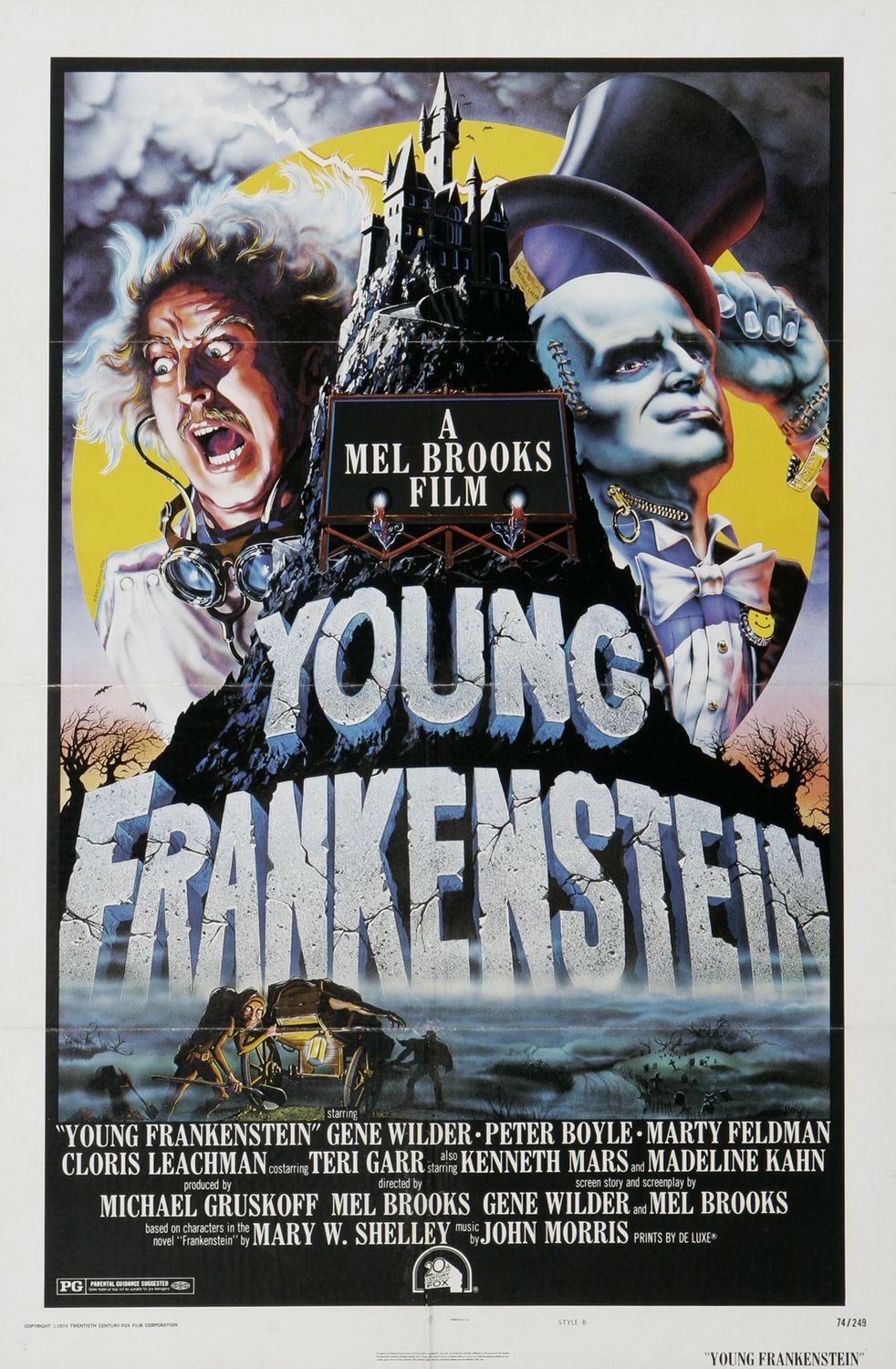
1974 was a good year for Mel Brooks.  By this point, he was essentially a household name and a staple in American comedy.  In February, he released his western classic 'Blazing Saddles' and a mere 10 months later, he was back in theaters with what many would deem another classic, 'Young Frankenstein.'

This macabre tale is that of Dr. Frederick Frankenstein (pronounced Fronkenshteen), a physician, lecturer, and direct descendent of the legendary Dr. Henry Frankenstein.  He has made a reputable career for himself in the scientific community but is unable to escape the shadow of his infamous ancestry for which he has nothing but contempt.  His life is turned upside down when he inherits his family's estate in Transylvania.  With the help of a loyal assistant, Igor and a busty handmaiden named Inga, Dr. Frankenstein confronts the mysteries of his past and attempts to finish his grandfather's work.

Gene Wilder throws himself into the role of Dr. Frankenstein in a way we haven't seen before.  His manner is that of someone truly mad, struggling to keep himself in check.  His fear that he is just as mad as his grandfather is always present in his performance though never expressly stated.  His raw frustration and fury bubbles under the surface, eating away at him.  What we get is an explosive, bipolar performance.  But is that necessarily a good thing?  While this ferocity may work for a horror film or drama, comedy demands a straight man, someone to take the brunt of the craziness around him.  Wilder is conflictive with his own creation.  He wants to act as both the exasperated straight man AND the bombastic mad genius and its hard to latch onto both.

Marty Feldman and his iconic eyes plays the hunchbacked Igor (pronounced Eye-gor).  Like Frederick, he too is a descendant of the character we all know.  Bug-eyed expression and warm dimwittedness carries him a long way.  He succeeds in the role despite the jokes he's forced to deliver.  More on that later.  Teri Garr plays Inga, a well-endowed personal assistant concerned for the good Doctor but equally curious and loyal to a fault.  The three of them work together as a team infinitely better than Bender and Vorobyaninov ever did 'The Twelve Chairs.' All three of them share great chemistry.


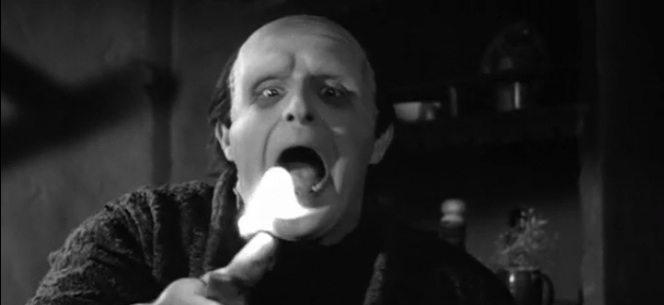
The late Peter Boyle plays The Monster (that's right, not Frankenstein, the Monster) and he is fantastic.  He plays the part, as all great Frankenstein's Monsters do, with a childlike understanding of a cruel and unforgiving world.  Despite being buried in prosthetics, Boyle has a remarkably expressive face that endears us to him.


Chloris Leachman has a small part as Frau Blücher, a housekeeper so horrifying that the very mention of her name is enough to frighten the horses.  Kenneth Mars plays Inspector Kemp, a one-armed policeman torn between wanting to maintain law and order in his community and wanting to get a good ol' fashioned riot going.  Madeline Kahn also appears briefly as a vain socialite who just won't put out.  She's barely in the movie but she makes the most out of every minute.

Young Frankenstein is Mel Brooks' most technically accomplished film to date.  While The Producers just told a comedic story and Blazing Saddles skewered westerns, Young Frankenstein has a far more specific target in its crosshairs, namely the Universal Horror Films, 'Frankenstein' and to a lesser extent, 'The Bride of Frankenstein.'  The cinematography by Gerald Hischfeld, production design by Dale Hennesy, and score by John Morris are all impressive the same way Tim Burton's 'Ed Wood' was.  However, I would hesitate to call it a classic, or even a wholly successful work.

Pacing wise, this movie is abysmal.  I was watching this film with a friend and we hadn't even gotten past the title sequence before my friend muttered, "these are going on forever."  She wasn't wrong.  The opening credits are simply names and crew positions superimposed over a shot of a looming castle while slow violin music plays.  The whole experience is reminiscent of 'Frankenstein' and films of that ilk but one thing those movies were not is funny.  In general, that is Young Frankenstein's greatest problem.  It mirrors the style of the horror film without countering with the timing of a comedy.  Not every joke in Blazing Saddles lands, but it is throwing a joke at you every 10 seconds.  The jokes in Young Frankenstein are far too infrequent and when they do appear they are hit and miss.

Wilder wrote the screenplay with Mel Brooks adding support and its painfully apparent.  That's not to say that there aren't good jokes, there are, but there are just as many clunkers that have no business being in this film.  At one point Gene Wilder arrives at a train station in Transylvania.  Despite the fact that the conductor has just told us that we have arrived in Transylvania, Wilder leans out the window to a passing Shoeshine boy and asks, "Pardon me, boy.  Is this the Transylvania station?"  The boy responds "Ja, ja.  Track 29."  He turns away before asking, "Hey, can I give you a shine?"  "No thank you" says Wilder.  Hilarious.  For those of you who are totally lost, "Track 29. Can I give you a shine?"  are lyrics from the 1941 song "Chattanooga Choo Choo."  First off, this is a stupid joke.  Second, it doesn't make any sense other than making the audience say "we know those lyrics."  And third, it steps over the REAL joke which is that Wilder was able to get to Transylvania by train.

Brooks is also far too fond of 'looking at the camera' humor.  9 times out of 10, its just Brooks explaining jokes to the audience.  "We must accept our failures with quiet dignity and grace" sighs Frankenstein before he throws a tantrum and cries.  Igor looks at the audience.  "Quiet dignity and grace."  He rolls his eyes.  "GET IT?!" shouts Brooks off camera.  "He didn't accept the situation with dignity and grace!"  Yes Mel.  We get it.


Once the Monster rises from his metal slab, the script picks up with its jokes.  It suddenly has purpose and direction.  One slapstick scene with the Monster and a generous Blind Hermit is particularly effective.  But at the same time, some elements of the story, like The Monster meeting a little girl by a well, are riffing on the 1931 film so specifically that I can't imagine they'd be anything other than chuckleworthy for an unfamiliar audience.  The scene serves no other purpose but to make fun of its predecessor scene by scene and in doing so, fails to work as its own narrative.  I'm not sure why this is viewed as a classic.  It's nowhere near as funny as The Producers or Blazing Saddles.  It is a well made visually but I've never known the average moviegoer to say "you should see this movie Young Frankenstein, the cinematography is Uh-May-Zing!"  That being said, there is more than enough in this movie to recommend.

Following the success of The Producers: the Musical, Brooks and company tried to milk that prized heifer again and turned Young Frankenstein into a Broadway Musical.  The show received mixed reviews and faded from the public consciousness.  Don't worry guys, we'll always have Transylvania.


Gene Wilder has gone on record saying that this is his favorite film he's ever been involved with.  I feel bad for the poor man.  He doesn't know how good 'Will Wonka and the Chocolate Factory' is.

Friday, February 27, 2015

The Director's Oeuvre: Mel Brooks - Blazing Saddles

In every sense, 'Blazing Saddles' feels like the movie Mel Brooks should have made after 'The Producers.'  With newfound confidence in his script, a strong cast, and a bigger budget, Brooks swings for the fences with this satirical western that shocks as often as it enthralls.


The story is about Bart, a black railroad worker who is appointed Sheriff of the small hick town of Rock Ridge by a conniving State Attorney General with hopes that he will insight unrest and run out the townspeople so he can buy the land cheap and build a railroad.  Its honestly not as complicated as it reads.

Cleavon Little plays Bart and he is as charming, charismatic, and likable as can be.  He takes the town's racism with good cheer and a smile that says "I get it. You're all bigots. And that's just the way things are."  The role requires someone eternally hopeful in a hopeless situation and Little absolutely nails it.

While the movie starts off a little rocky, one-note, and goofy for goofy's sake, the story picks up quite a bit when Gene Wilder appears as Jim, the fastest, drunkest hands in the West.  Wilder is effortlessly funny and his unassuming mug makes his speed all the more surprising.  The camaraderie between Jim and Bart is one of the highlights of the movie.


Madeline Kahn is decent as Lili Von Shtupp.  I honestly can't tell if she's trying or not.  She does get some classic one-liners in though.  "They're always coming and going and going and coming and always too soon."  I must confess that my disappointment in her role is entirely on me.  Lili is constantly referred to as one of the great comedy characters and I'm not sure why.  She's not as big a part as history would like to remember.  She's just another adversary for Bart to convert, nothing special.  I just hope you think that lisp humor is hiwawious.

But the real star of the movie is Harvey Korman as Hedey, sorry, Hedley Lamarr.  He plays the conniving State Attorney General who is continually frustrated by Bart's success in Rock Ridge.  His seething anger and dastardly villainy is a thing of wonder.


Mel Brooks is the weakest part of the movie as a cross-eyed moron, Governor William J Lepetomane, a role that exists solely so Brooks can have a part in his own movie.  I wonder if his check from the paddleball people cleared.

I can't stress how shocking this movie is.  The original title of the film was 'TEX X', "dock that chink a day's pay for nappin' on the job!" is one of the opening lines of the film, and the use of the N-word alone would make Quentin Tarantino blush.  There is a boldness present we haven't seen from Brooks before.  And yet, the film is more than just a shock fest/satire of Western tropes.  Its also a pointed criticism about the way minorities of all sorts were exploited, including African Americans, Asian Americans, Native Americans, and large-breasted secretaries.


The Looney Tunes humor feels a little tacked on, as though they didn't know what joke to put there but they knew they had to have one.  But this movie is shooting from the hip with a new joke or gag every 10 seconds.  If one of them doesn't work, and many of them don't, there will be a new one shortly.

The last act of the movie pushes meta humor, an element that will define Mel Brooks' career, to its limits with a twist so extreme even M Night Shyamalan wouldn't dare try it.  I won't spoil it here.  I'm sure at the time this was an unparalleled example of self-referential comedy but it goes on far too long as though Brooks made a list of every gag he could think of and then filmed them regardless of how long funny it was.

A recurring element in Mel Brooks' filmography is that even if you haven't seen his stuff, you've seen it referenced.  This holds true for Blazing Saddles more than any other film in his career thus far, and for good reason.  It's just that funny.

Wednesday, February 18, 2015

The Director's Oeuvre: Mel Brooks - The Twelve Chairs

While everybody emphasizes the importance of a director's first film, I believe that the second film is more important.  With your first film, you cut your teeth.  With your second film, and a larger budget, you prove your worth.  Quentin Tarantino followed 'Reservoir Dogs' with Pulp Fiction' and Steven Spielberg followed 'The Sugarland Express' with 'Jaws' while Marc Webb followed '(500) Days of Summer' with 'The Amazing Spider-man' (sigh).


This brings us to 'The Twelve Chairs', Mel Brooks' sophomore effort, in which he trades strong characters and clever dialogue for scale, and loses at every turn.

Based on a famous Russian novel of the same name, the movie follows three greedy men as they search high and low, racing back and forth across Russia to get their hands on twelve gold-encrusted chairs, one of which contains a fortune of jewels.

Ron Moody plays Vorobyaninov, an aristocrat wiped out by the communist revolution.  When the movie begins, his dying mother-in-law tells him that she has hidden her valuables from the Bolsheviks by sewing them inside one of her ornate chairs.  Desperate to return to his old way of life, Vorobyaninov sets out to retrieve the chair.

A clever, handsome, and homeless conman named Ostap Bender, played by a young Frank Langella deduces Vorobyaninov's true intentions and the pair are off to find the treasure.  Dom DeLuise plays a local priest who abandons his post to join the hunt but he's mostly there to pad out the runtime.

Mel Brooks is featured front and center in the poster and yet he is barely in the film.  Ironically, though I've never been a great fan of Brooks as an actor, he's the best part of this movie by far.  It's a shame that he couldn't be the main character, or even a bumbling sidekick for more than five minutes.

The Twelve Chairs is an uneasy film.  It's not what you would call messy, just uninspired and unmotivated.  It is based on an old Russian novel of the same name.  Apparently this is one of 18 different adaptations.  I can only assume that Brooks decided to do the comedic version of the story but he only half commits.  Often the style feels amateur and unsure.  Not since Benny Hill have I seen so much sped up footage in one comedy.  I can only assume its because the footage was too slow, so they ratched up the tempo and added a lot of "whoop whoop" noises to make it funny.  The cinematography is decent and the locations are certainly beautiful but Brooks never gives us a moment to appreciate it.  He's in such a hurry to make this feel like some sort of 'Mad, Mad, Mad, Mad World' type caper that he fails to involve us in the characters, the mystery, or the world around them.


I can't say I ever felt anything for the characters.  I never wanted them to succeed, I just hoped that maybe this chair would be the fabled chair and the story would be over with.  Eventually, I grew frustrated with Vorobyaninov and Ostap as human beings and with Mel Brooks as a storyteller.  At no point do Moody and Langella ever compliment one another as a team.  Bender has a plan.  Vorobyaninov can't contain himself and does something stupid.  Bender restrains him or saves him and thinks of a new plan.  Wash, rinse, repeat.

Without strong characters or compelling relationships, comedies rely on exceptional set pieces.  The Twelve Chairs certainly has set pieces, it rushes from one scenario to the next, but every single scene is unfulfilled and they all feel abandoned, as though Brooks lost confidence half way through and jumped ship.  There is a fun scene at a circus involving a high wire act but like every other scene, it lacks the proper build up and pay off.  Everything about this movie is a creative anomaly and the word "funny" is merely conceptual.  Mel Brooks was a comedian and a drummer before he was a filmmaker.  He knows the importance of rhythm.  And yet this movie exists in a race to finish itself.  It's in a hurry to cease being.

Tuesday, February 17, 2015

The Director's Oeuvre: Mel Brooks - The Producers (1967)

A few friends and I started a club as a means of keeping in touch. One of us will choose a director and together we'll go through that director's films one at a time and talk about them. Currently, we're going through the career of comedy legend, Mel Brooks, and what better place to start than with his first film, 'The Producers.'


The Producers serves as Mel Brooks' debut and what a debut it is. While most people think of Brooks as a parodist, there was a period, however briefly when he made comedies that worked as their own movies.

The story is absolute genius. A once-great producer MAX BIALYSTOCK teams up with a nebbish accountant LEO BLOOM with a cockamamie scheme, namely that if they raise a ludicrous amount of money and they put on a guaranteed flop, they could abscond with the leftover money and retire as millionaires. From a comedic standpoint, this plot is filled to bursting with hilarious opportunities and for the most part, The Producers makes the most out of them.

Zero Mostel plays Max Bialystock and while many know him as Tevye from Fiddler on the Roof, this was the role he was born to play. He's delightfully repugnant as one of the failed giants of his craft. How low does he go? The film begins with him selling his body to little, horny old ladies for "checkies," his sweaty combover barely keeping up with him as he runs from one geriatric tryst to the next.

Gene Wilder has his breakout performance as Leo Bloom, a spineless accountant with a propensity for panic attacks and a slavish devotion to his security blanket. Its his clever hypothetical accounting theory that lays out the plot but its Max Bialystock's desperation, at one point reaching his hands to the heavens and shouting "LORD, I WANT THAT MONEY!" that sets the story into motion. Wilder and Mostel make one hell of a team in this movie and their chemistry is off the charts.

The two set out to find the worst play ever written and they strike gold in "SPRINGTIME FOR HITLER", a concept so audacious, you already know about it by reputation. The author of this masterpiece is Franz Liebkind played by Kenneth Mars, as a Nazi and Hitler devotee who escaped the war and immigrated to the US of A. Play in hand, Bialystock and Bloom assemble the crew for their theatrical catastrophe, including a flamboyantly gay director, Joel Schumacher before Joel Schumacher, Roger De Bris. His utter creative bankruptcy is one of the consistent laughs throughout the film.

The only sour note is Dick Shawn as Lorenzo St. DuBois or LSD for short (get it?). He's a beatnik so terrible he just has to be right. However, he is representative of all the problems I have with the second act.

WARNING! HERE BE SPOILERS!


After LSD joins the cast, the pacing goes down the tubes, the slowest moment being LSD's musical number "Love Power" which is so boring and drawn out that it is completely absent from the Broadway Musical. Indeed, Lorenzo's character has been excised entirely.

The play opens to everyone's predictable outrage with Wilder and Mostel exiting before any of the angry patrons. They leave a hair too early though because as soon as LSD sets foot on stage, his hippy portrayal of the mustachioed dictator has the audience in (unbelievable) stitches. This is where I am going to disagree with people but I firmly believe that the scenes in the theater threaten to destroy the movie entirely. Why? Because the manner in which the play is presented makes no sense. "Oh shush, Lukas. It's a comedy." you say. But the core concept is flawed. Roger DeBris intends to make a sincere, dramatic work. His problem is that he's such a poor director that even when he intends to be serious, he falls back on his tired, old, and lets not be coy about it, gay clichés. But what I don't understand is how LSD made it all the way to opening night with that performance accepted by DeBris and with the Kraut being none-the-wiser. LSD is terrible, undoubtedly, but he's too terrible.

Some will say that I'm overanalyzing a simple joke, but allow me to point you to the remake, which is almost word for word the original film, but with musical numbers and a dramatically restructured second act. As mentioned before, in the musical there is no LSD. Leibkind is cast as his beloved Führer and intends to play the role with all the sincerity he can muster. However, on opening night, he breaks his leg and can't go on. He is replaced last minute... by Roger DeBris! This is an ingenious change. 'Springtime For Hitler' now takes on a different satirical edge. DeBris doesn't know he's awful. His homosexuality shines through. He is utterly incapable of playing the part straight.

The rest of the musical is very similar to the movie, except for a few character changes. Leo having a secret desire to be a Broadway Producer adds some complexity and depth to an otherwise shallow role but apart from that it's basically verbatim. And why should it change? The screenplay for Mel Brooks' comedy is downright untouchable. It has a reputation for being one of those great comedies and its entirely deserved. You've heard lines from this movie without even knowing it. "Actors aren't animals? Have you ever eaten with one?!"

It is clear that Mel Brooks poured his heart and soul into this project and it really is required viewing for anyone who says they like comedy. With movies like "Young Frankenstein" and "Robin Hood: Men in Tights", Mel Brooks will become one of Hollywood's premier satirists. Its clear, even from his first film, that he has a firm grasp on the concept.