Showing posts with label 80s. Show all posts

Wednesday, April 1, 2015

Oeuvre: Tim Burton - Batman

The sequels and remakes have used the additives of 'Returns', 'Forever', 'Begins', 'V. Superman', and 'And Robin' but 25 years ago, there was only one 'BATMAN.'


While you know all the players, you may not know the plot.  Orphaned billionaire Bruce Wayne protects Gotham City as the masked vigilante known as Batman.  His life is complicated when he falls for Vicki Vale, a famed photographer pursuing the true identity of the fabled Batman.  But when an old enemy returns from the dead as the twisted Joker, Wayne must put his personal interests aside and stop this madman once and for all.

There's a whole generation out there who think Batman begins and ends with Nolan and that Burton's films, while revolutionary for the time, are dated by todays standards.  While that is occasionally true, there is still much to admire.  A quarter of a century later, 'Batman' still stands out for its dark imagery and mythic atmosphere.


Michael Keaton is a Batman.  He doesn't overcompensate with a deep, gravely voice.  He rarely speaks in anything over a whisper.  Everything about his Batman is minimal, from his quiet but stern composure signifying that he is, in fact, badass, to his simple, pitch black costume, thanks to Bob Ringwood.  But where Keaton truly excels is as Bruce Wayne.  The character has proven impossible to capture by everyone who has played the part by everyone except Christian Bale and Keaton.  Keaton's Wayne is vulnerable, bordering on aloof.  He's a slightly stuttering recluse who doesn't know how to talk to people.  You'd never guess that he puts on a cowl and beats up muggers but that's what is so great about him.

The object of Wayne's affections Vicki Vale played by Kim Basinger, a last minute replacement for Sean Young.  What makes her character so interesting is that she begins the story pursuing Batman but turns her eye to Wayne who she finds more interesting and elusive.  Almost any other movie would have the opposite, no matter how predictable.

Michael Gough is a considerably better Alfred Pennyworth than Michael Caine ever was.  Like everything else in this movie, he's understated compared to Nolan's often self-important reboot.

And then there's the show-stealing Jack Nicholson as Jack Napier but you can call him... the Joker, a maniacal lunatic who plans to take over Gotham with the ingenious use of cosmetics.  Lex Luthor can keep his real estate schemes, our guy's got makeup!  Nicholson plays the part very traditionally.  He is slightly more ominous than Cesar Romero ever was but he's also just plane goofy.  He has a prosthetic grin permanently stretched on his face but you feel that Jack would have been smiling like that regardless of the makeup.  He's clearly having a ball.


One aspect of the story that I admire greatly is the Batman/Joker dynamic.  You get the same "you made me!  No, you made me!" talk that all superhero movies feel the need to saddle themselves with, but here we get a variety.  Batman confronts Jack Napier, the Joker confronts Bruce Wayne, and finally, Batman confronts the Joker.  With every interaction the relationship is different and in every scene it grows.  That's rare, even for superhero movies these days.

Danny Elfman's score opens the film and presents itself as the most memorable Superhero score next to John Williams' Superman over a decade earlier.  Sparing a very few exceptions, these two giants have not been topped.  It's ominous, its fast, its energetic, its just Batman.  But the rest of the soundtrack is pretty fantastic too.  The Joker's motif, 'Waltz to the Death' is fun to listen to and works incredibly well when juxtaposed to the grim aesthetic.  And the track 'Descent into Mystery' which plays as Batman travels back to the Batcave for the first time gives me chills.

With the help of Production Designer Anton Furst, Burton's Gotham is a thing to behold.  Skyscrapers so high they pierce the thick, story clouds that shroud Gotham in a perpetual darkness.  Wayne's mansion feels authentically exaggerated and his Batcave will continue to set the gold standard by which all other Batcaves will be judged.  The world exists in a timeless age, where men wore trench coats and fedoras, but computers also exist.  And yet, it never detracts from the story.


There are things that age the story (I'm looking at you, Prince!), and there are massive jumps of logic that some won't be able to make (where did all those goons on the church rooftop come from, anyway?) but if you're willing to look past all that, I think Tim Burton's Batman is a treat.  There are so many aspects of the movie that still haven't been topped, despite the six films that have followed it.  But if you think its unique, wait till you get a load of 'Batman Returns.'


Thursday, March 26, 2015

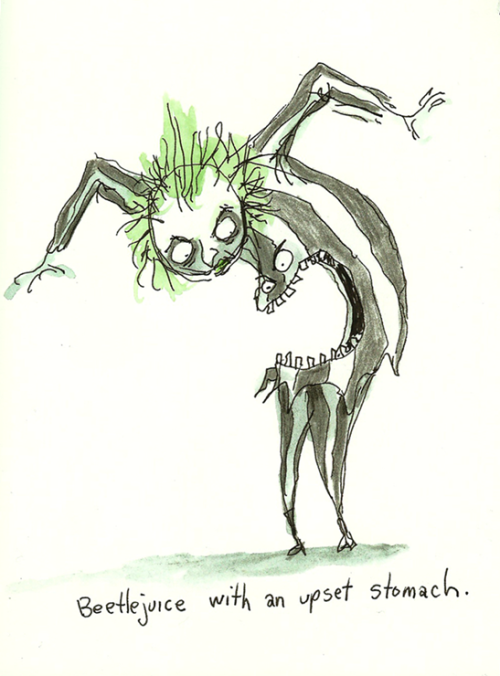
Oeuvre: Tim Burton - Beetlejuice

Last month, I stressed the importance of a filmmaker's sophomore effort.  A great deal of importance is placed of a director's first film, as it should be.  It's the film that gets your foot in the door.  It's often treated as a "Here's who I am!" statement.  But its the next film, with more experience and a greater budget, that you plant your feet, spread your arms wide and declare "This is who I CAN be!"  With 'Beetlejuice', Burton shows his true colors.  Turns out its a lot of blacks and whites.  But also, a whole lotta fun!


Alec Baldwin and Geena Davis play Adam and Barbara Maitland, a couple  hopelessly, dorkily in love.   He spends most of his time in the attic building a model of their quaint little town and she buys him a can of furniture oil and they're both really excited about it.  Norman Rockwell could not invent these two.

But there's trouble in paradise.  The lovers die in a freak accident and return home as ghosts only to discover that their beloved house has been infested by a dysfunctional family from New York.  Unable to scare away the unwanted inhabitants, the newly-deads turn to a sleazy, disgusting spirit for assistance.


All, literally all of the characters in this movie are a lot of fun.  There's no weak point.  Alec Baldwin and Geena Davis are charming and delightfully inoffensive and yet they're never boring.  They accept their fate with a sense of bewilderment and curiosity, refusing to let death get them down.

Jeffrey Jones, Catherine O'Hara and a young Winona Ryder play the Deetzes, the family that buys the haunted house.  The father, Charles Deetz is a big land developer who came out to the country for some piece and quiet.  Perfectly content with this old-fashioned lifestyle, he even comes with a copy of "American Birds."  Catherine O'Hara plays a wicked step-mother of sorts as Delia, a no-talent artist, crawling out of her skin out in the sticks.  With the help of Otho (Glenn Shadix), a vaguely homosexual interior decorator/spiritual, the two tear down the perfectly nice home and rebuild it into a gaudy, modern catastrophe.  Winona Ryder plays Lydia, a slightly suicidal goth with a flair for photography.  She's so morbid that she can see the deceased and agrees to help the lovely couple.  All of these people are cartoons and they should be hair-tugging annoying, but they're all funny in their own ways and compliment one another.

Then there's the world of the dead, a DMV for the recently deceased headed by Sylvia Sidney as a heavy-smoking caseworker.  Its a scene filled with tons of sight gags, colorful characters, and marvelously simple special effects.

But the real star of this movie is Michael Keaton as the bio-exorcist and titular Beetlejuice.  I really can't stress enough how fantastic he is in this film.  In every scene, he jumps off the screen.  He plays the part as a used car salesman meets the Genie.  He's a mad tornado of crass and filth.  Keaton was robbed at the Academy Awards last year for his brutally honest performance in 'Birdman' but he wasn't even nominated for his performance in this.  Unforgivable.


Legend says that following the surprise success of 'Pee-wee's Big Adventure', Burton began searching for a new project to pursue.  However, he was despondent after script after script of unoriginal ideas.  He was about to give up hope, when at the bottom of a mountain of listless screenplays, he found a concept bursting with unique imagery that fit Burton like a glove.

The Production Design by Bo Welch, the Art Direction by Tom Duffield, the Set Decoration by Catherine Mann, the Costume Design by Aggie Guerard Rodgers, and the Makeup by Ve Neill, Steve LaPorte, and Robert Short, for which they won an Oscar, are all top notch.  The effects aren't perfectly polished.  At no point, do I forget that we're on sets on a soundstage somewhere, but that's part of the charm.  It's all rough and tumble.

The score by Danny Elfman is iconic.  Whenever anyone makes a movie about conniving spirits, this theme is bound to show up in the trailer or TV spots and for good reason.  Like the characters, the scenery, the special effects, and everything else about the movie, its chock full of personality.

Burton directs this story with a precise deliberation and a fantastic imagination.  The stop-motion animation, particularly a snake within a snake that looks like something from 'Dune.'  His excitement and love for every aspect of filmmaking is tangible and I spent most of the movie grinning ear to ear.  There's a scene at the dinner table involving a choreographed dance sequence, shrimp cocktails, and the Banana Boat Song by Harry Belafonte.  The last act in particular, when Beetlejuice makes his way into the human world, is a hilarious thrill ride.  When I saw this film as a kid, I remember not laughing.  Not because it wasn't funny, it is, but because I couldn't understand what I was watching.  What is happening in this movie?  Its unexpected, unpredictable, and wholly original.  I can't imagine NOT liking this film.  It's a blast.


Extra Tidbit.  Some crazy individuals with too much time and even more talent made an awesome Beetlejuice Rollercoaster in Minecraft.  Check it out here...

Oeuvre: Tim Burton - Pee-wee's Big Adventure

Once upon a time, there was a school called CalArts.  In this school, legendary Disney animators, men of great talent who worked with Walt himself, met in classroom A113 to teach a new generation of talented youngsters the art of animation.  These artists would grow to change the face of the industry forever.  They included Pixar founder, John Lasseter, Iron Giant director, Brad Bird, stop-motion titan, Henry Selick, and a shy, thin, quiet young man with dark clothes, tangly, wiry hair, and an affinity for German expressionism named Tim Burton.

Shortly after graduating, Burton and several other students went to work for the Mouse House and Burton was given the chance to direct a short film of his own creation.  The film, 'Frankenweenie', which we will get to eventually, was deemed "too dark for children" and Burton was fired.  But all was not lost, for a man named Paul Reubens saw the movie.  Impressed with this up-and-coming director's visual style, Reubens offered Burton the chance to direct his first feature film based on a television show Reubens conceived and starred in.  Burton agreed and that brings us to 'Pee-Wee's Big Adventure.'


The world that Pee-wee inhabits must seem alien and Neverland Ranchy to the uninitiated but I will try my best to explain.  Pee-Wee is a grown man with the mind of a child.  He is not mentally retarded, rather he has in him the spirit and logic of youth.  This is never expressly stated, but the movie does its best to convey, from his amazing house complete with fire pole, a Breakfast Machine that would make Rube Goldberg's mouth water, and a secret room hidden in a hedge containing Pee-wee's most prized possession, his Bike, that Pee-wee lives in the best possible world as perceived by a child.  Adults behave how children perceive them to behave.  Serious at one moment and silly the next, to the eye-rolling embarrassment of Pee-Wee.  "If I were grown up, this is how things would be!"

Pee-wee's bike, the envy of all, is stolen during one of Pee-wee's daily trips to the Magic Shoppe.  The Police won't help and so Pee-wee embarks on a cross country road trip to reclaim his lost treasure.

Reubens is really a marvel as Pee-wee Herman.  He has been playing the part for almost 35 years now.  The character is an absurd creation.  Mathematically, it should be creepy and yet, it works.  Its entirely possible that Pee-wee Herman is the perfect vessel for this sort of performance.  Can you imagine Paul Reubens bringing that sort of logic to Willy Wonka?

The screenplay by Paul Reubens, Michael Varhol, and the late, great Phil Hartman is brimming with energy and humor.  It hops from one small story to the next with a feverish determination.  In a mere 90 minutes, we are treated to dinosaurs, water wrestling, an escaped convict with a real dark past, singing hobos, clown doctors, a bucking bronco, the Alamo, a leather clad biker gang, and a ghost story from a trucker named Large Marge, my personal favorite.  There's so much more going on in this movie, almost too much, but the throw-it-at-the-wall-and-see-what-sticks approach really works to this film's benefit.

Reubens was all, "Your loss, Disney," and gave the Disney reject the opportunity to direct his very first feature film. That Disney reject was Tim Burton.

If you watch Frankenweenie or any of Burton's college shorts like 'Vincent', you can see that Burton's vision was sharply defined even at a young age.  However, his trademark style is not fully apparent here, though glimpses of his skewed doors and preference for black and white stripes do appear here and there, as does his love of stop-motion animation.  The production design by David L. Snyder is fun and the editing by Billy Weber is fine.  Weber has edited Days of Heaven, The Warriors, Beverly Hills Cop, Top Gun, Midnight Run, The Thin Red Line, Miss Congeniality, The Love Guru, and The Tree of Life.  What a strange career that man has had.

The only part of this movie that is definitively Burton is the score by lead singer of Oingo Boingo, Danny Elfman.  The soundtrack is bouncy and robust though far more lighthearted than his more iconic scores we will hear in the near future.  

Overall, 'Pee-wee's Big Adventure' is a fun film with a great sense of imagination and a slightly tweaked universe.  Burton directs with a firm hand and there's never a moment where I felt like he didn't know what he was going for.  This is by no means a "substantial film" but it is a good time.

Wednesday, March 11, 2015

Oeuvre: Mel Brooks - Spaceballs


Brooks has satirized westerns, silent films, horror films, Hitchcock thrillers, and period piece epics.  Each genre as important to film history as the other.  But in 1987, Brooks took aim at the film that revolutionized entertainment and changed the way films were made, and indeed marketed, forever.  STAR WARS.


The story is awfully familiar.  Lone Starr, a rebellious space pirate and his loyal companion, Barf, attempt to rescue the beautiful Princess Vespa as President Skroob, Colonel Sandurz, and the evil Dark Helmet threaten to destroy the peaceful planet of Druidia.

Bill Pullman is charming Lone Starr, a dashing rogue with a mysterious past.  He and Candy have legitimately good chemistry and the two would make a good team in a better movie.  Looking at him, you think, "I would vote for that man if he ran for President."

Daphne Zuniga plays Princess Vespa.  She's very attractive and willing which is all the part required. She is constantly pursued, though never aided by her servant, a trashy golden robot named Dot Matrix, voiced by the late Joan Rivers.  I constantly felt bad for Joan.  Her character doesn't do anything and I can't imagine Joan found any of these jokes funny.  She's forced to deliver lines like, "I couldn't hold my oil."

The two shining stars of this galactic farce are John Candy as Barf (hear me out) and Rick Moranis as Dark Helmet.  Both are playing to type but they embrace it so thoroughly, its hard not to laugh.  Candy plays Lone Starr's co-pilot, a Mog (half man, half dog, his own best friend) and his cowardly sincerity, wagging tail, and perky ears go a long way.  But the real winner in this picture is Dark Helmet and the inspired casting of Rick Moranis.  Moranis made a career out of playing lovable losers.  Here he is appropriately, hilariously dweeby and pathetic.  Making "Darth Vader has asthma" jokes is nothing new but this is the first time it felt earned.  He squeezes every drop of comedy out of the character.

Brooks plays two roles.  His scenes as the malevolent President Skroob are often funny.  His scenes as Master Yogurt (get it?) are not.


Unlike Brooks' more successful parodies, Blazing Saddles and Young Frankenstein, the social commentary and the plot don't ever move hand in hand.  The merchandising of Star Wars, as inescapable now as it was 40 years ago, never effectively synchronizes with the plot.  The result is a comedy that stops for jokes and a plot that doesn't mean anything.

This is a really strange film for Brooks, not because there isn't comedic fruit, people have been making fun of these movies for decades, but because while Blazing Saddles made fun of westerns, High Anxiety made fun of Alfred Hitchcock's filmography, and History of the World made fun of period piece epics, Spaceballs is making fun of one film specifically.  Its even more specific than Young Frankenstein.  The film doesn't so much reference or poke fun at other science fiction films or tropes as it does mention them directly ("Why not?  It worked in Star Trek.").  This could have been a parody of how films tried to copy the Star Wars formula with diminishing returns.  Instead, it becomes one of them.

Long gone are the days of The Producers when Brooks would write a cohesive story.  Spaceballs is so rigidly tied to Star Wars' structure that it is incapable of breathing.  Its hampered by a spine that wasn't meant to be funny, and in the few moments it breaks away from that skeleton, like when Dark Helmet fulfills his deepest fantasies with action figures, it suddenly snaps back into its unfunny plot.  The Producers set out to find a play so horrible that it would be a surefire flop.  Blazing Saddles put a black sheriff in charge of a racist town.  Notice something similar?  Both plots contain comedic conflict.  And here is Spaceballs' plot synopsis according to IMDB, "Planet Spaceball's President Skroob sends Lord Dark Helmet to steal Planet Druidia's abundant supply of air to replenish their own, and only Lone Starr can stop them."  Where is the comedy in that?  From the names, I guess.

This movie may be the definition of "it was funny at the time" humor.  In the first 10 minutes, we already have two bumper sticker jokes.  Jabba the Hutt is replaced by Pizza the Hutt and its the only time Brooks outdoes Lucas.  Jabba is a fat slug but Pizza the Hutt is flat out revolting.  Now if only the gag made us laugh instead of... gag.  But then there are things that are dated or just plain boring to begin with.  Michael Winslow, the funny noise guy from Police Academy, remember him?  Yeah, he's here to do the same schtick.  The only people to do something original with that premise were Key and Peele.  But then there's jokes about matching luggage, industrial strength hair dryers, and robotic henchmen who talk like 20s New York gangsters and wear zoot suits.  The Millennium Falcon is replaced with a Winnebago and in the climax, the bad guys' ship turns into a giant robotic cleaning lady with a vacuum.  It sucks.

And don't get me started on Yogurt and the Schwartz.  Is this a Schwarzenegger joke?  Is it a jewish sounding word?  I don't know but what's worse, I ain't laughin.


That being said, there were things I really enjoyed about the movie.  As previously mentioned, Lone Starr and Barf (just keeps getting funnier, Mel) have great chemistry.  They make a good team and I would have liked to see them together in something not Han and Chewbacca related.  A weak scene involving Star Trek beaming and butt displacement has a hilarious, laugh out loud payoff.  And there was also one scene that really, honest to God, impressed me.  There is a scene by campfire on the desert planet of Not-Tattooine-Really-Please-Don't-Sue, where Lone Starr and Princess Vespa discuss their pasts.  She is to marry a prince she doesn't love but considers sacrifice part of her duties as a princess.  Lone Starr flirts by telling her that physical contact isn't all its cracked up to be.  Its a genuine scene and it genuinely works.

One of the defining traits of Mel Brooks' career has been his passion for meta comedy.  He has implemented it as an unexpected finale of 'Blazing Saddles' and he has used it as a crutch when he couldn't think of an ending for 'History of the World.'  Now Brooks embraces the insanity and brandishes the absurdity with a bold confidence.  Star Wars is, after all, the film that practically defined merchandising.  I would go so far as to wager that it was the Spaceballs merchandising joke alone that inspired Brooks to make this entire film.  Around half way through the movie, the hapless villains are at a loss for what to do.  "We'll consult the videotape!" declares Colonel Sandurz.  They open up their VHS collection, containing all of Brooks' previous filmography, and pop in Spaceballs.  They fast forward, black and white squiggles covering what we've already seen in a way that only those of the VHS generation will remember.  Then they reach where we are now.  Dark Helmet and Sandurz see themselves in real time.  The movie is watching itself.    This is it, guys, the singularity.  The only way to go further will be for the movie to show us the ending at the middle and be done with it.


Only one aspect of this movie really interested me on an intellectual level.  With so many shots of people shouting out "the Schwartz!" in awe, it did make me chuckle thinking about how stupid Mark Hamill, Harrison Ford, Carrie Fischer, and Alec Guinness must have felt, talking about nonsense like "Jedi Knights" and "the Force."  What the hell is a Jedi anyway?  The only difference is that Star Wars has a shelf life of forever and Spaceball has a shelf life of about 15 minutes.

This film has one major problem that I jut can't overlook and that is that it is very negative and mean-spirited towards the subject matter.  I know that I can't be impartial.  My love for Star Wars goes back longer than I can remember.  But I couldn't shake the feeling that Brooks really doesn't like Star Wars and that, in the end, he just thinks its stupid.  Try as he might, he's always under Star Wars' shadow.  Go watch Family Guy's "Blue Harvest" if you want to see a Star Wars parody done right.  Not every joke lands, but most of them do and there's love in the work.  Brooks comes across as resentful and bitter at what Star Wars has done to the world.  But his movie doesn't exist on its own.  Its not a glaring take-down or even a chink the the armor.  Its a crass, ugly film that tries to be funny and occasionally succeeds but never lets us forget, with every bit of gross-out humor, and every lightsaber dick joke, and every empty second devoid of laughter, that we could be watching an infinitely better film.

Monday, March 9, 2015

Oeuvre: Mel Brooks - History of the World. Part I

It's good to be the King.  Not so great to be an audience member.


'History of the World. Part I' is an uneven, overlong, tired comedy of clichés and jokes as old as the time periods it lampoons.

Essentially, Brooks is satirizing epic period pieces, breaking this film into 5 chapters; the Stone Age/Dawn of Man, the Old Testament, the Roman Empire, the Spanish Inquisition, and the French Revolution.

We begin with an homage to Stanley Kubrick's '2001: A Space Odyssey' and masturbating apes, laying to rest my suspicions that this was indeed going to be a long 92 minutes.  Both the Cavemen and the world they inhabit look like instillations at the American Museum of Natural History.  There is one clever joke in the entire segment, one, in which we see a Caveman painting and creating art for the first time.  "With the birth of the artist came the inevitable afterbirth... the critic."  Then Mel goes and ruins a perfectly good joke by having another Caveman piss on the wall.  I check my watch.

The Old Testament has a famous joke about there being 15 Amendments until Moses dropped one.

The Roman Empire contains the lion's share of the screen time, roughly 41 minutes.  It tells the story of a stand-up philosopher, a slave, and a virgin who desperately want to flee Rome.  Lots of adding 'us' to the end of names.

The Spanish Inquisition is essentially one eight minute Las Vegas style musical number.  Its as hit and miss as it sounds.

The movie actually picks up steam with the French Revolution segment, where it takes on a Prince and the Pauper type romp.  Of all the segments, this one feels like it could be its own movie and its a shame that Brooks didn't cut the rest and focus on this story entirely.  The sever dichotomy between the poor and the wealthy alone is ripe for comedy.  Brooks is at his disgusting best as the King, forcing a woman to sleep with him to free her father from prison.  Unfortunately, Brooks has little interest in the plight of the peasants and the story rushes to and messy climax before pulling the rug out from under us in an ending so lazy and maddening that it soured the entire movie for me.  Alas.


Mel Brooks plays Moses, Torquemada, Jacques, and King Louis XVI but his most substantial role is Comicus, a stand-up philosopher who isn't as funny as Mel Brooks thinks he is.  He should be playing Narcissus.

Gregory Hines plays Josephus, a slave who can dance and call people "Honkus."

Dom DeLuise continues to play fat people who used to have more characteristics but they ate them all.  History calls him Emperor Nero.

Madeline Kahn plays Nympho, a character who speaks entirely in lame double entendres while Mel Brooks strokes himself off camera.

Harvey Korman appears in the last sketch as Count de Money.  The big (only) joke here is that people keep calling him Money, a callback to Korman's Hedley Lamar in 'Blazing Saddles.'  A real knee-slapper (sarcasm).  A slightly more highbrow joke would be for people to keep calling him Manet, but class has never been in Brooks' wheelhouse.  Besides, we have more piss jokes to tell.

Chloris Leachman plays Madame Defarge, whom the more well-read will know as a revolutionary in Charles Dickens' 'A Tale of Two Cities.'  She has little to do and Brooks is merciful by not making a Madame Defart joke.  The audience breaths a sigh of relief.

The film also contains the biggest waste of Orson Welles since the infamous Paul Masson commercial but with far fewer laughs.

Far more talented actors only get one role while Brooks gets five.  Why not bring everyone back and make this the Cloud Atlas of comedy?  Madeline Kahn is a talented comedian and is constantly underused.  Why not have her play multiple roles?  Because Mel Brooks would get tired of kissing the same pair of tits.  That's why.


Almost every scene in this movie is a clunker.  Brooks seems to know this, and for the most part, keeps every scene down to three minutes.  He never tries to establish a cohesive through-line or purpose to these set pieces.  There is no rhyme or reason to their length.  Each "story", and ultimately the movie itself, only lives as long as Mel Brooks can think of jokes to pile on to this weary skeleton.  He could only come up with 10 jokes for the Spanish Inquisition so its only 8 minutes.  He thought there were loads of jokes he could write about Rome.  So its five times as long.

This is a comedy of labels rather than ideas.  Brooks seems to think that shouting "GAYS!" or "JEWS!" is funny.  People are not inherently funny.  They are the baseline of a joke.  "An alcoholic, a priest, and a child molester walk into a bar" is not a joke.  It is a setup.  "An alcoholic, a priest, and a child molester walk into a bar... and that's just the first guy."  THAT'S a joke.  At one point during the Spanish Inquisition, Torquemada cries, "we've flattened their fingers, we've branded their buns, nothing is working... send in the nuns!"  At that point, a line of nuns march out, remove their coifs and gowns and diving into a pool for a synchronized swimming routine, where they do nothing religious and cease to be nuns entirely.  So why have them be nuns in the first place?  Because nuns are funny to look at?  Because "nun" is a funny word to say?  Nothing is working, indeed.

I feel like a teacher lecturing the class clown.  Mel, you're coasting on passing grades and the odd chuckle.  I know you can be better than this.  I just wish you'd try harder.  For the rest of you, go see what Monty Python is doing with 'Life of Brian' and 'Monty Python and the Holy Grail.'  Now that's an A student.