Showing posts with label Madeline Kahn. Show all posts

Monday, March 9, 2015

Oeuvre: Mel Brooks - History of the World. Part I

It's good to be the King.  Not so great to be an audience member.


'History of the World. Part I' is an uneven, overlong, tired comedy of clichés and jokes as old as the time periods it lampoons.

Essentially, Brooks is satirizing epic period pieces, breaking this film into 5 chapters; the Stone Age/Dawn of Man, the Old Testament, the Roman Empire, the Spanish Inquisition, and the French Revolution.

We begin with an homage to Stanley Kubrick's '2001: A Space Odyssey' and masturbating apes, laying to rest my suspicions that this was indeed going to be a long 92 minutes.  Both the Cavemen and the world they inhabit look like instillations at the American Museum of Natural History.  There is one clever joke in the entire segment, one, in which we see a Caveman painting and creating art for the first time.  "With the birth of the artist came the inevitable afterbirth... the critic."  Then Mel goes and ruins a perfectly good joke by having another Caveman piss on the wall.  I check my watch.

The Old Testament has a famous joke about there being 15 Amendments until Moses dropped one.

The Roman Empire contains the lion's share of the screen time, roughly 41 minutes.  It tells the story of a stand-up philosopher, a slave, and a virgin who desperately want to flee Rome.  Lots of adding 'us' to the end of names.

The Spanish Inquisition is essentially one eight minute Las Vegas style musical number.  Its as hit and miss as it sounds.

The movie actually picks up steam with the French Revolution segment, where it takes on a Prince and the Pauper type romp.  Of all the segments, this one feels like it could be its own movie and its a shame that Brooks didn't cut the rest and focus on this story entirely.  The sever dichotomy between the poor and the wealthy alone is ripe for comedy.  Brooks is at his disgusting best as the King, forcing a woman to sleep with him to free her father from prison.  Unfortunately, Brooks has little interest in the plight of the peasants and the story rushes to and messy climax before pulling the rug out from under us in an ending so lazy and maddening that it soured the entire movie for me.  Alas.


Mel Brooks plays Moses, Torquemada, Jacques, and King Louis XVI but his most substantial role is Comicus, a stand-up philosopher who isn't as funny as Mel Brooks thinks he is.  He should be playing Narcissus.

Gregory Hines plays Josephus, a slave who can dance and call people "Honkus."

Dom DeLuise continues to play fat people who used to have more characteristics but they ate them all.  History calls him Emperor Nero.

Madeline Kahn plays Nympho, a character who speaks entirely in lame double entendres while Mel Brooks strokes himself off camera.

Harvey Korman appears in the last sketch as Count de Money.  The big (only) joke here is that people keep calling him Money, a callback to Korman's Hedley Lamar in 'Blazing Saddles.'  A real knee-slapper (sarcasm).  A slightly more highbrow joke would be for people to keep calling him Manet, but class has never been in Brooks' wheelhouse.  Besides, we have more piss jokes to tell.

Chloris Leachman plays Madame Defarge, whom the more well-read will know as a revolutionary in Charles Dickens' 'A Tale of Two Cities.'  She has little to do and Brooks is merciful by not making a Madame Defart joke.  The audience breaths a sigh of relief.

The film also contains the biggest waste of Orson Welles since the infamous Paul Masson commercial but with far fewer laughs.

Far more talented actors only get one role while Brooks gets five.  Why not bring everyone back and make this the Cloud Atlas of comedy?  Madeline Kahn is a talented comedian and is constantly underused.  Why not have her play multiple roles?  Because Mel Brooks would get tired of kissing the same pair of tits.  That's why.


Almost every scene in this movie is a clunker.  Brooks seems to know this, and for the most part, keeps every scene down to three minutes.  He never tries to establish a cohesive through-line or purpose to these set pieces.  There is no rhyme or reason to their length.  Each "story", and ultimately the movie itself, only lives as long as Mel Brooks can think of jokes to pile on to this weary skeleton.  He could only come up with 10 jokes for the Spanish Inquisition so its only 8 minutes.  He thought there were loads of jokes he could write about Rome.  So its five times as long.

This is a comedy of labels rather than ideas.  Brooks seems to think that shouting "GAYS!" or "JEWS!" is funny.  People are not inherently funny.  They are the baseline of a joke.  "An alcoholic, a priest, and a child molester walk into a bar" is not a joke.  It is a setup.  "An alcoholic, a priest, and a child molester walk into a bar... and that's just the first guy."  THAT'S a joke.  At one point during the Spanish Inquisition, Torquemada cries, "we've flattened their fingers, we've branded their buns, nothing is working... send in the nuns!"  At that point, a line of nuns march out, remove their coifs and gowns and diving into a pool for a synchronized swimming routine, where they do nothing religious and cease to be nuns entirely.  So why have them be nuns in the first place?  Because nuns are funny to look at?  Because "nun" is a funny word to say?  Nothing is working, indeed.

I feel like a teacher lecturing the class clown.  Mel, you're coasting on passing grades and the odd chuckle.  I know you can be better than this.  I just wish you'd try harder.  For the rest of you, go see what Monty Python is doing with 'Life of Brian' and 'Monty Python and the Holy Grail.'  Now that's an A student.

Friday, March 6, 2015

The Director's Oeuvre: Mel Brooks - High Anxiety

1977 was a watershed year for filmmaking.  George Lucas was reshaping the way we viewed popcorn entertainment with Star Wars and Woody Allen was elevating comedy with a newfound maturity with Annie Hall.  The same year, Mel Brooks dug his heels in deep and declared himself for what he has always been, a parodist.  And with that, we have 'High Anxiety.'

High Anxiety Movie Poster

Dr. Richard Thorndyke is a psychoanalyst who suffers from a severe case of acrophobia, a fear of heights.  He arrives at the Psychoneurotic Institute for the Very, Very Nervous (great name) where he is to serve as the new administrator.  Slowly, Thorndyke begins to suspect that things are not as they seem.  People are framed for murder, the lunatics have taken over the asylum, excreting pigeons occupy jungle gyms, bellboys accost hotel patrons, and normal people act like cocker spaniels.  In other words, a normal day in LA.

If it feels like something you've seen before, that's because it is.  High Anxiety is a take down of suspense thrillers, namely the oeuvre of the master of suspense, Alfred Hitchcock.  The script reads like someone dropped all of Alfred Hitchcock's screenplays and hastily reassembled them, and from a stylistic standpoint, it totally works.

Mel Brooks stars once again as Dr. Thorndyke and while his introduction begins with a subtly amusing gag, I can never shake the feeling that his movies would be better with a different actor.  Apparently, this role was originally offered to Gene Wilder but scheduling conflicts forced him to step away.  What a shame.


But never fear! Harvey Korman and Cloris Leachmen return as Dr. Charles Montague and Nurse Diesel.  Leachman plays "Stern German Mistress" like nobody's business and Korman thrives at playing frustrated villains who aren't nearly as dangerous as they think they are.  The two get to work together here and their perverse, sadomasochistic love affair is a thing to behold.  All their work with Mel Brooks has led to this moment, as though Young Frankenstein's Frau Blücher and Blazing Saddles' Hedley Lamarr and his Froggy were destined to be together.  Its beautiful.

Madeline Kahn continues her Brooks alum winning streak as Victoria Brisbane, a breathy, busty blonde a la Tippi Hedren and Kim Novak.  I'm frequently impressed with how gracefully she slides into these movies and, just like most of her appearances so far, she is underused but memorable.

The big achievement in this movie is the way Brooks pokes fun at the Hitchcock style.  At times, the stylistic replication of Universal Horror films in 'Young Frankenstein' was a detriment to the films overall pacing but here it works undeniably to the film's advantage, with insert shots, transitional shots, and extreme close-ups skewed just enough to make it recognizable and comical.  Its not haha funny, just clever.

The film is, after all, a satire.  Half the jokes are straight up gags and the other half are exaggerating Hitchcock's most distinctive elements.  Where the film truly excels is when the two meet, like when Brooks hears that the person he is replacing was... MURDERED.  Familiar Bernard Herman strings take over.  Dramatic dutch angles of our horrified hero, looking every which way.  Then we reveal a symphony practicing in the tour bus driving next to them.  Its ludicrous, but it works.


The score, by Brooks' frequent collaborator, John Morris mimics Bernard Herman's compositions so well its almost creepy.  Morris also wrote the music for another comedy whodunit, CLUE.  He's a musical chameleon, a Michael Giacchino before Michael Giacchino.

When the film is at its weakest, it tries to make jokes that have nothing to do with the subject its spoofing.  At one point the movie comes to a screeching halt for a musical number.  The song in question, "High Anxiety" is written, composed, and performed by Brooks as well.  One can only assume that he was paid less than scale and could only make a living by wearing as many hats as humanly possible.  The scene simply doesn't work.  Is it a parody of a Hitchcock film?  I don't think so.  Its a weak five minutes that would have been on the Cutting Room floor if not for Brooks' vanity.  I'm pretty sure its just Mel playing Sinatra for five minutes.  Mel Brooks does in the real world what most of us only do in the shower.  And he's getting paid for it!

The single greatest moment in the entire film is the payoff to a drawn out joke involving Dr. Thorndyke pestering a lobby boy for a newspaper.  "I'll get it!" he shrieks.  The joke falls completely flat.  Surely the actor just overplayed it for a lame joke.  Then it keeps going.  Still overacting.  Still lame.  A few minutes later, Thorndyke is in the shower.  A familiar shadow looms beyond the curtain before they are yanked aside to reveal the bellboy with curled newspaper in hand.  "HERE! HERE! HERE!" he shouts, his high pitched screeches replacing the iconic score.  Brooks falls to the ground, bringing the curtain down with him.  The Bellhop exits.  The newspaper ink bleeds into the drain.  Genius.

The references are all clear as day, THE BIRDS, PSYCHO, NORTH BY NORTHWEST, THE MAN WHO KNEW TOO MUCH, SHADOW OF A DOUBT, REAR WINDOW, and VERTIGO, only here they call it "high anxiety."  As Groundskeeper Willie once asked, "you want to get sued?"

While Silent Movie felt masturbatory, self-congratulatory, and smug, High Anxiety shows an evolution to Brooks.  The film is a devotion to craft and it shows that the filmmaker is more than just a joke teller.  He loves the films he's lambasting and what's more, he understands why they work and how to make it work for him.  This film may not be the game changer that Annie Hall was but shows effort and originality and that's good enough for me.


Wednesday, March 4, 2015

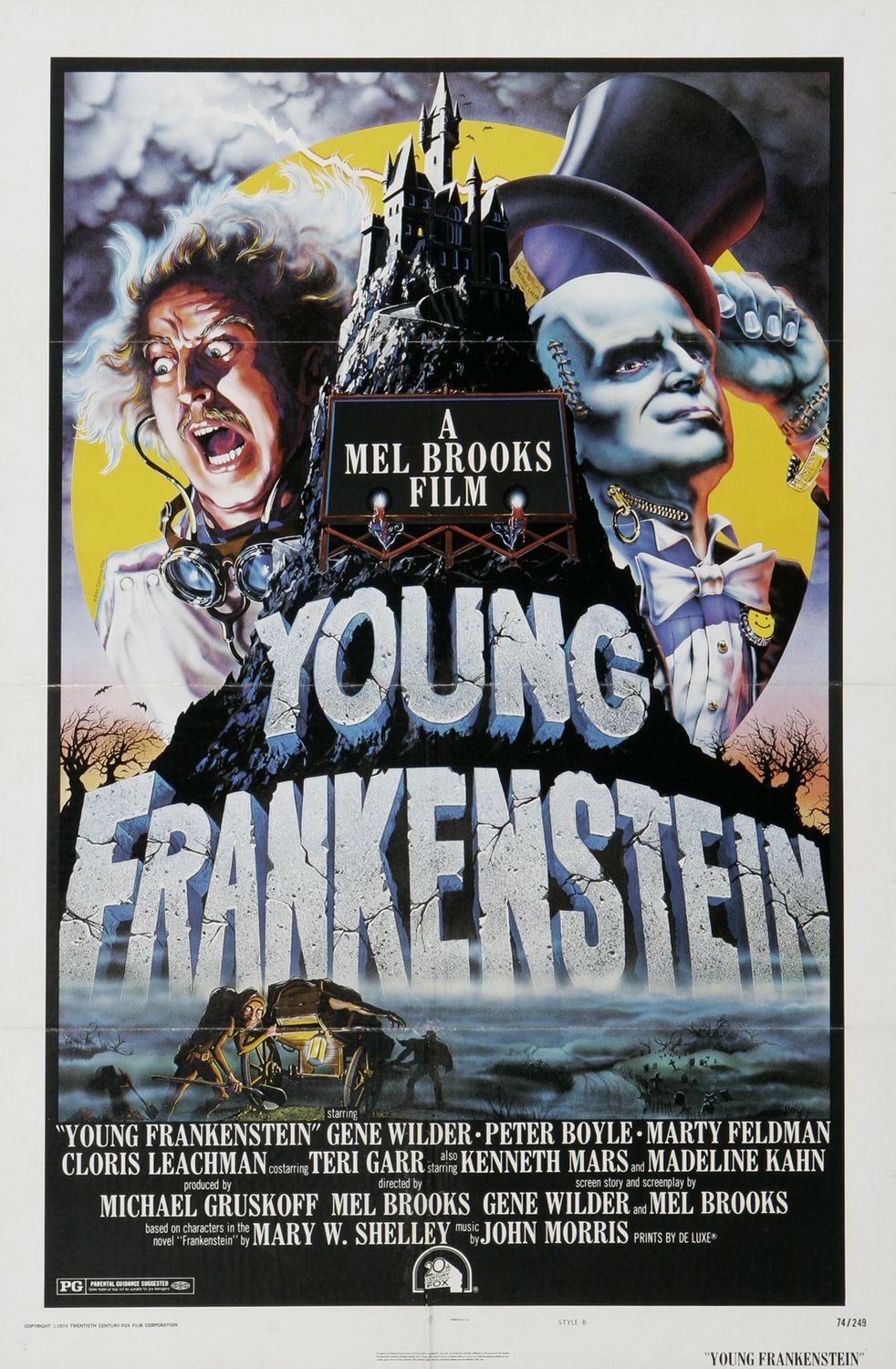
The Director's Oeuvre: Mel Brooks - Young Frankenstein

1974 was a good year for Mel Brooks.  By this point, he was essentially a household name and a staple in American comedy.  In February, he released his western classic 'Blazing Saddles' and a mere 10 months later, he was back in theaters with what many would deem another classic, 'Young Frankenstein.'

This macabre tale is that of Dr. Frederick Frankenstein (pronounced Fronkenshteen), a physician, lecturer, and direct descendent of the legendary Dr. Henry Frankenstein.  He has made a reputable career for himself in the scientific community but is unable to escape the shadow of his infamous ancestry for which he has nothing but contempt.  His life is turned upside down when he inherits his family's estate in Transylvania.  With the help of a loyal assistant, Igor and a busty handmaiden named Inga, Dr. Frankenstein confronts the mysteries of his past and attempts to finish his grandfather's work.

Gene Wilder throws himself into the role of Dr. Frankenstein in a way we haven't seen before.  His manner is that of someone truly mad, struggling to keep himself in check.  His fear that he is just as mad as his grandfather is always present in his performance though never expressly stated.  His raw frustration and fury bubbles under the surface, eating away at him.  What we get is an explosive, bipolar performance.  But is that necessarily a good thing?  While this ferocity may work for a horror film or drama, comedy demands a straight man, someone to take the brunt of the craziness around him.  Wilder is conflictive with his own creation.  He wants to act as both the exasperated straight man AND the bombastic mad genius and its hard to latch onto both.

Marty Feldman and his iconic eyes plays the hunchbacked Igor (pronounced Eye-gor).  Like Frederick, he too is a descendant of the character we all know.  Bug-eyed expression and warm dimwittedness carries him a long way.  He succeeds in the role despite the jokes he's forced to deliver.  More on that later.  Teri Garr plays Inga, a well-endowed personal assistant concerned for the good Doctor but equally curious and loyal to a fault.  The three of them work together as a team infinitely better than Bender and Vorobyaninov ever did 'The Twelve Chairs.' All three of them share great chemistry.


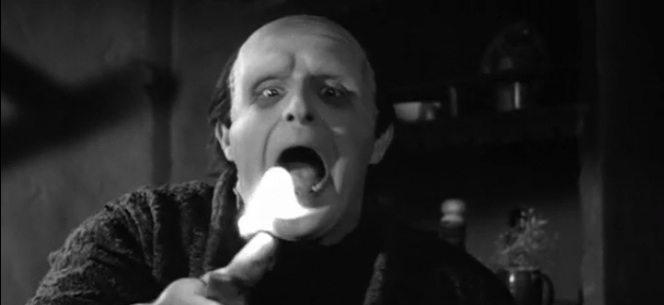
The late Peter Boyle plays The Monster (that's right, not Frankenstein, the Monster) and he is fantastic.  He plays the part, as all great Frankenstein's Monsters do, with a childlike understanding of a cruel and unforgiving world.  Despite being buried in prosthetics, Boyle has a remarkably expressive face that endears us to him.


Chloris Leachman has a small part as Frau Blücher, a housekeeper so horrifying that the very mention of her name is enough to frighten the horses.  Kenneth Mars plays Inspector Kemp, a one-armed policeman torn between wanting to maintain law and order in his community and wanting to get a good ol' fashioned riot going.  Madeline Kahn also appears briefly as a vain socialite who just won't put out.  She's barely in the movie but she makes the most out of every minute.

Young Frankenstein is Mel Brooks' most technically accomplished film to date.  While The Producers just told a comedic story and Blazing Saddles skewered westerns, Young Frankenstein has a far more specific target in its crosshairs, namely the Universal Horror Films, 'Frankenstein' and to a lesser extent, 'The Bride of Frankenstein.'  The cinematography by Gerald Hischfeld, production design by Dale Hennesy, and score by John Morris are all impressive the same way Tim Burton's 'Ed Wood' was.  However, I would hesitate to call it a classic, or even a wholly successful work.

Pacing wise, this movie is abysmal.  I was watching this film with a friend and we hadn't even gotten past the title sequence before my friend muttered, "these are going on forever."  She wasn't wrong.  The opening credits are simply names and crew positions superimposed over a shot of a looming castle while slow violin music plays.  The whole experience is reminiscent of 'Frankenstein' and films of that ilk but one thing those movies were not is funny.  In general, that is Young Frankenstein's greatest problem.  It mirrors the style of the horror film without countering with the timing of a comedy.  Not every joke in Blazing Saddles lands, but it is throwing a joke at you every 10 seconds.  The jokes in Young Frankenstein are far too infrequent and when they do appear they are hit and miss.

Wilder wrote the screenplay with Mel Brooks adding support and its painfully apparent.  That's not to say that there aren't good jokes, there are, but there are just as many clunkers that have no business being in this film.  At one point Gene Wilder arrives at a train station in Transylvania.  Despite the fact that the conductor has just told us that we have arrived in Transylvania, Wilder leans out the window to a passing Shoeshine boy and asks, "Pardon me, boy.  Is this the Transylvania station?"  The boy responds "Ja, ja.  Track 29."  He turns away before asking, "Hey, can I give you a shine?"  "No thank you" says Wilder.  Hilarious.  For those of you who are totally lost, "Track 29. Can I give you a shine?"  are lyrics from the 1941 song "Chattanooga Choo Choo."  First off, this is a stupid joke.  Second, it doesn't make any sense other than making the audience say "we know those lyrics."  And third, it steps over the REAL joke which is that Wilder was able to get to Transylvania by train.

Brooks is also far too fond of 'looking at the camera' humor.  9 times out of 10, its just Brooks explaining jokes to the audience.  "We must accept our failures with quiet dignity and grace" sighs Frankenstein before he throws a tantrum and cries.  Igor looks at the audience.  "Quiet dignity and grace."  He rolls his eyes.  "GET IT?!" shouts Brooks off camera.  "He didn't accept the situation with dignity and grace!"  Yes Mel.  We get it.


Once the Monster rises from his metal slab, the script picks up with its jokes.  It suddenly has purpose and direction.  One slapstick scene with the Monster and a generous Blind Hermit is particularly effective.  But at the same time, some elements of the story, like The Monster meeting a little girl by a well, are riffing on the 1931 film so specifically that I can't imagine they'd be anything other than chuckleworthy for an unfamiliar audience.  The scene serves no other purpose but to make fun of its predecessor scene by scene and in doing so, fails to work as its own narrative.  I'm not sure why this is viewed as a classic.  It's nowhere near as funny as The Producers or Blazing Saddles.  It is a well made visually but I've never known the average moviegoer to say "you should see this movie Young Frankenstein, the cinematography is Uh-May-Zing!"  That being said, there is more than enough in this movie to recommend.

Following the success of The Producers: the Musical, Brooks and company tried to milk that prized heifer again and turned Young Frankenstein into a Broadway Musical.  The show received mixed reviews and faded from the public consciousness.  Don't worry guys, we'll always have Transylvania.


Gene Wilder has gone on record saying that this is his favorite film he's ever been involved with.  I feel bad for the poor man.  He doesn't know how good 'Will Wonka and the Chocolate Factory' is.

Friday, February 27, 2015

The Director's Oeuvre: Mel Brooks - Blazing Saddles

In every sense, 'Blazing Saddles' feels like the movie Mel Brooks should have made after 'The Producers.'  With newfound confidence in his script, a strong cast, and a bigger budget, Brooks swings for the fences with this satirical western that shocks as often as it enthralls.


The story is about Bart, a black railroad worker who is appointed Sheriff of the small hick town of Rock Ridge by a conniving State Attorney General with hopes that he will insight unrest and run out the townspeople so he can buy the land cheap and build a railroad.  Its honestly not as complicated as it reads.

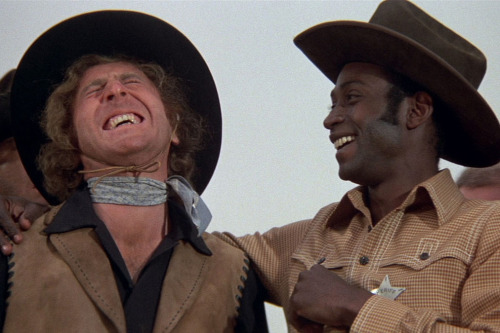
Cleavon Little plays Bart and he is as charming, charismatic, and likable as can be.  He takes the town's racism with good cheer and a smile that says "I get it. You're all bigots. And that's just the way things are."  The role requires someone eternally hopeful in a hopeless situation and Little absolutely nails it.

While the movie starts off a little rocky, one-note, and goofy for goofy's sake, the story picks up quite a bit when Gene Wilder appears as Jim, the fastest, drunkest hands in the West.  Wilder is effortlessly funny and his unassuming mug makes his speed all the more surprising.  The camaraderie between Jim and Bart is one of the highlights of the movie.


Madeline Kahn is decent as Lili Von Shtupp.  I honestly can't tell if she's trying or not.  She does get some classic one-liners in though.  "They're always coming and going and going and coming and always too soon."  I must confess that my disappointment in her role is entirely on me.  Lili is constantly referred to as one of the great comedy characters and I'm not sure why.  She's not as big a part as history would like to remember.  She's just another adversary for Bart to convert, nothing special.  I just hope you think that lisp humor is hiwawious.

But the real star of the movie is Harvey Korman as Hedey, sorry, Hedley Lamarr.  He plays the conniving State Attorney General who is continually frustrated by Bart's success in Rock Ridge.  His seething anger and dastardly villainy is a thing of wonder.


Mel Brooks is the weakest part of the movie as a cross-eyed moron, Governor William J Lepetomane, a role that exists solely so Brooks can have a part in his own movie.  I wonder if his check from the paddleball people cleared.

I can't stress how shocking this movie is.  The original title of the film was 'TEX X', "dock that chink a day's pay for nappin' on the job!" is one of the opening lines of the film, and the use of the N-word alone would make Quentin Tarantino blush.  There is a boldness present we haven't seen from Brooks before.  And yet, the film is more than just a shock fest/satire of Western tropes.  Its also a pointed criticism about the way minorities of all sorts were exploited, including African Americans, Asian Americans, Native Americans, and large-breasted secretaries.


The Looney Tunes humor feels a little tacked on, as though they didn't know what joke to put there but they knew they had to have one.  But this movie is shooting from the hip with a new joke or gag every 10 seconds.  If one of them doesn't work, and many of them don't, there will be a new one shortly.

The last act of the movie pushes meta humor, an element that will define Mel Brooks' career, to its limits with a twist so extreme even M Night Shyamalan wouldn't dare try it.  I won't spoil it here.  I'm sure at the time this was an unparalleled example of self-referential comedy but it goes on far too long as though Brooks made a list of every gag he could think of and then filmed them regardless of how long funny it was.

A recurring element in Mel Brooks' filmography is that even if you haven't seen his stuff, you've seen it referenced.  This holds true for Blazing Saddles more than any other film in his career thus far, and for good reason.  It's just that funny.