Monday, April 27, 2015

Oeuvre: Tim Burton - Edward Scissorhands

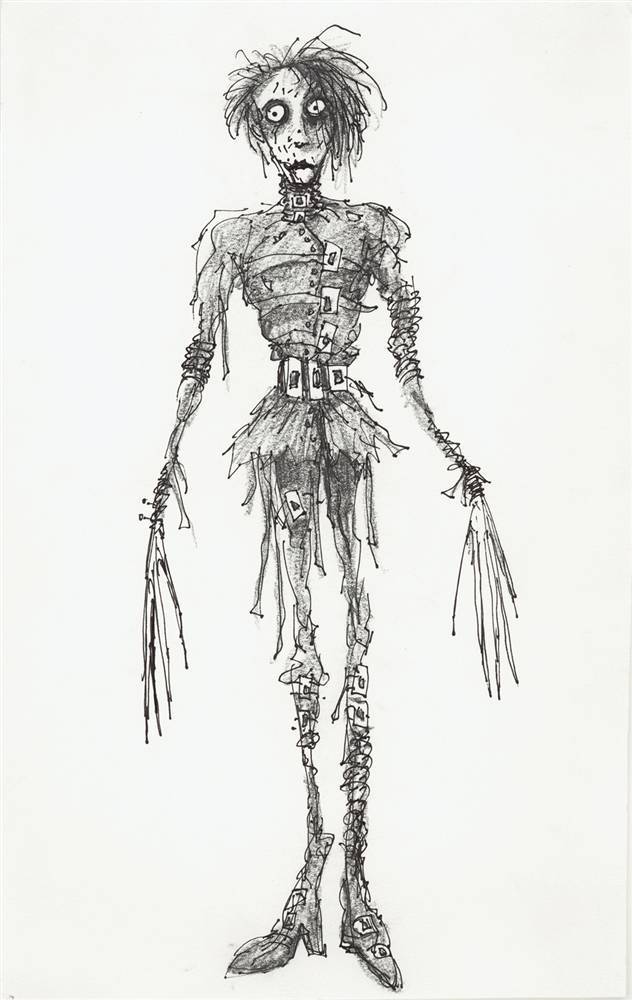
After the ground-shaking success of BATMAN, Tim Burton had free reign to do whatever he wanted. While some directors use their clout to make big budget, original movies that otherwise wouldn't have been made, (cough, Christopher Nolan, cough) Burton went small and personal, and so we have Edward Scissorhands.


You probably know the story of Edward Scissorhands by now. And if you don't, you at least recognize the unforgettable images or have heard Danny Elfman's equally unforgettable score.  A lonely inventor creates a man but dies before he can finish him, leaving the man with only scissors for hands.  When an innocent Avon lady accidentally discovers him, she brings him home to her small suburban neighborhood, where he becomes very popular among the bored townsfolk.

Johnny Depp makes his Burton debut as the titular Edward Scissorhands.  Known primarily as a teen heartthrob from 21 Jump Street and A Nightmare on Elm Street, Depp curls inward as the shy, misunderstood character. Depp speaks less than 170 words in the entire film and yet his performance is clear and touching.

Dianne Wiest plays Peg, a devoted wife and caring mother, but also a door-to-door makeup salesperson. In many ways, she is similar to Edward. She's optimistic and eternally kind despite being continually downtrodden and disrespected by her neighbors.  She is married to Alan Arkin, who could not be more All-American Dad if he tried.

In any love story, you need a love interest.  Kim, played by Winona Ryder is a girl next door type whose teenage attitude makes her fear Edward and reject him as a freak.  However, she has a good heart and a patient spirit like her mother and finds herself warming to him, much to the annoyance of her boyfriend Jim, played by Brat Pack alum,  Anthony Michael Hall.  He plays a jock who treats Edward like a child and pretends, in his own callous way, to be friends with him.
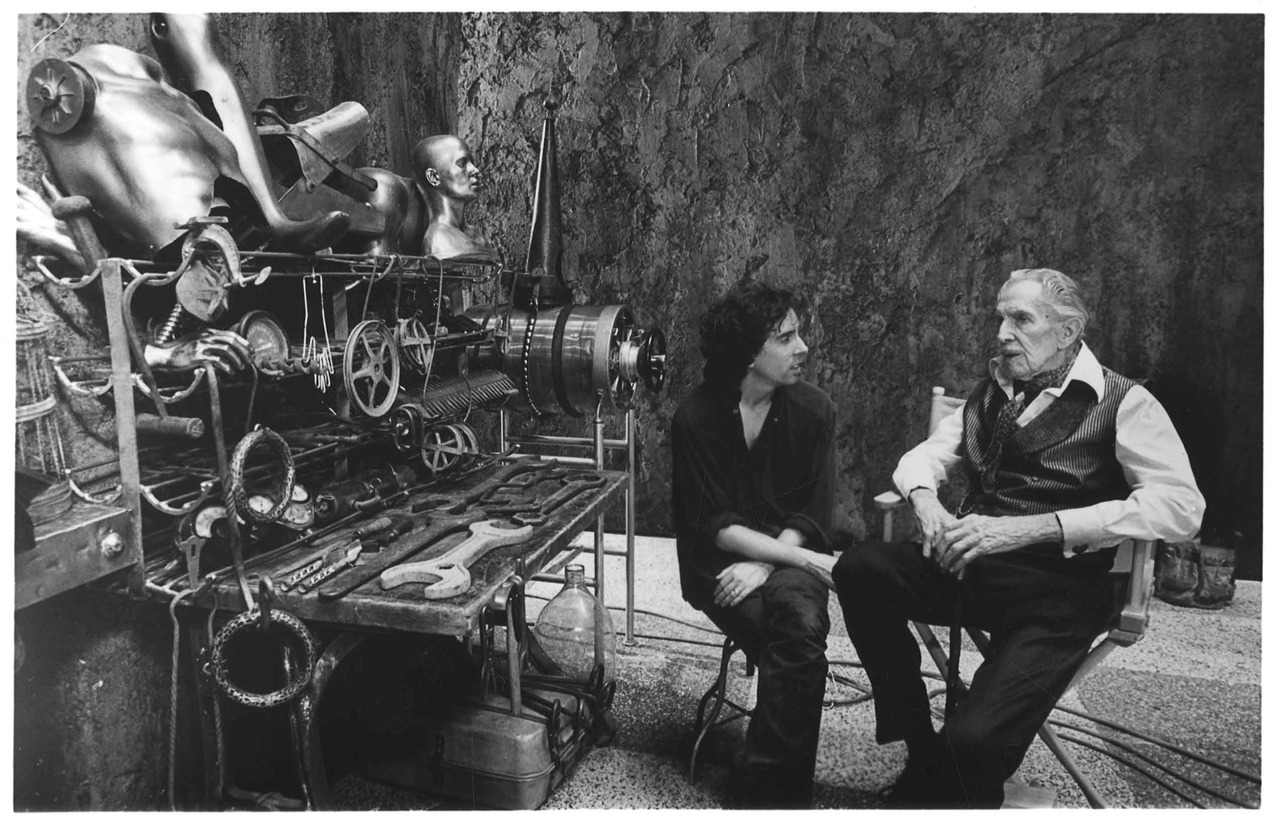

And finally, there is the lonely Inventor played by Vincent Price.  He is inspired to invent Edward while looking at a cookie baking machine of his own creation.  It's that kind of movie.  His role was expanded in the script, but Price was very old, and his battle with emphysema and Parkinson's meant that most of his scenes were cut.  Fittingly, the last scene he shot for the film, that of his death, would be the last thing Price would film in his life.  He passed away shortly thereafter but his role in this movie, however brief, is charming and endearing.

This may be the most Tim Burtony movie of all time.  It is the perfect confluence of his talents.  Once again, his American heritage mixes with his German influences, and while they merged smoothly in Batman, here they clash but they clash beautifully.  Edward Scissorhands exists in a reality slightly skewed from ours.  Peg's pink Avon uniform stands out vibrantly against the gothic castle.  Edward's pale skin and gravity defying hair make him stick out like a sore thumb amongst the clean cut "normal" people that surround him.  His contempt for the American suburbs is fully on display here as well.  The houses are painted in garish Easter pastels and all the men leave for work at exactly the same time, but there is also a scary, dark castle atop a scary, dark mountain that comes out of nowhere.  If it weren't for the fairy tale elements of this movie, one could argue it is riddled with plot holes and marred by dramatic simplicity but it totally works.  If you wonder where Edward gets the blocks of ice, you're asking the wrong questions.
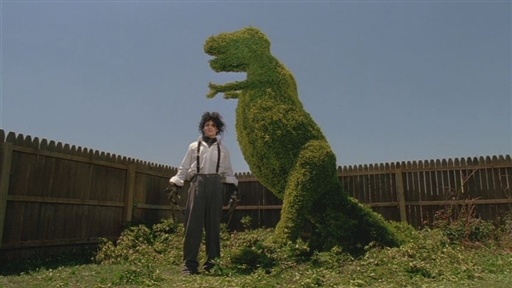

One of the deeper, darker concepts this movie explores is our relationship with phenomena.  Edward is treated with admiration and curiosity but he's nothing more than a novelty to most of the town.  These people are terribly bored.  To them, he is something to gawk at, and when he doesn't behave the way they want him to, he's something to fear.  They are more than happy to believe that he is a thief, a sex offender, and even a murderer despite all evidence to the contrary.  Even Peg, the well-meaning mother, is corrupted by Edward's presence.  As Edward becomes more and more popular, she starts to use him as a means of increasing her social value.

In a deeply troubling scene, Peg sits with Kim and admits that she should never have brought Edward down from that castle.  That their lives would have been better if he had just stayed up there forever.  Its upsetting because even Peg, one of Edward's most passionate defenders, thinks its better for Edward to be locked away in desperately lonely isolation, instead of hoping that others will grow to acknowledge and love him as they do.  Its a dismissal of humanity's worth as a whole.

The only pure person in this movie isn't Edward, its the Inventor, a man who created life out of the emptiness in his heart.  Edward is a child and can be molded as one.  Left to his own devices, he cuts his face.  He hurts everything he touches but longs for human interaction.  His very first lines are "don't go."  He wants to understand the world around him and sees beauty everywhere, but even he is corrupted by the world he is forced to inhabit.  In our culture, he experiences desire and longing, but with it come jealousy and violence.  Edward, it seems, is not meant for this world.


It's impossible to separate the artist from the art in this case.  I'm not referring to Burton's fondness for vibrant colors, black blacks and pale makeup.  I'm referring to Edward as a character and Burton's childhood in Burbank.  At its core, the story is about a lonely young man, who doesn't understand people.  He becomes an artist and even achieves a small level of fame before being chased out of the town he never asked to be a part of.  Edward and Burton even look alike, with the same pale skin and trademark straggly hair.  This only contributes to the film's feeling of honesty.  There is something true about Edward Scissorhands and I think it's because its the most personal movie Tim Burton ever made.

What Burton creates here is a modern day fairy tale; the story of where snow comes from.  The film is intensely moving, thanks in no small part to Depp's performance and Elfman's score.  One scene in particular, in which Winona Ryder asks Edward to hold her always draws a tear from my eye.  Edward Scissorhands is a deeply beautiful, tragic love story that deserves to be seen by everybody. Its just that good.

Wednesday, April 1, 2015

Oeuvre: Tim Burton - Batman

The sequels and remakes have used the additives of 'Returns', 'Forever', 'Begins', 'V. Superman', and 'And Robin' but 25 years ago, there was only one 'BATMAN.'


While you know all the players, you may not know the plot.  Orphaned billionaire Bruce Wayne protects Gotham City as the masked vigilante known as Batman.  His life is complicated when he falls for Vicki Vale, a famed photographer pursuing the true identity of the fabled Batman.  But when an old enemy returns from the dead as the twisted Joker, Wayne must put his personal interests aside and stop this madman once and for all.

There's a whole generation out there who think Batman begins and ends with Nolan and that Burton's films, while revolutionary for the time, are dated by todays standards.  While that is occasionally true, there is still much to admire.  A quarter of a century later, 'Batman' still stands out for its dark imagery and mythic atmosphere.


Michael Keaton is a Batman.  He doesn't overcompensate with a deep, gravely voice.  He rarely speaks in anything over a whisper.  Everything about his Batman is minimal, from his quiet but stern composure signifying that he is, in fact, badass, to his simple, pitch black costume, thanks to Bob Ringwood.  But where Keaton truly excels is as Bruce Wayne.  The character has proven impossible to capture by everyone who has played the part by everyone except Christian Bale and Keaton.  Keaton's Wayne is vulnerable, bordering on aloof.  He's a slightly stuttering recluse who doesn't know how to talk to people.  You'd never guess that he puts on a cowl and beats up muggers but that's what is so great about him.

The object of Wayne's affections Vicki Vale played by Kim Basinger, a last minute replacement for Sean Young.  What makes her character so interesting is that she begins the story pursuing Batman but turns her eye to Wayne who she finds more interesting and elusive.  Almost any other movie would have the opposite, no matter how predictable.

Michael Gough is a considerably better Alfred Pennyworth than Michael Caine ever was.  Like everything else in this movie, he's understated compared to Nolan's often self-important reboot.

And then there's the show-stealing Jack Nicholson as Jack Napier but you can call him... the Joker, a maniacal lunatic who plans to take over Gotham with the ingenious use of cosmetics.  Lex Luthor can keep his real estate schemes, our guy's got makeup!  Nicholson plays the part very traditionally.  He is slightly more ominous than Cesar Romero ever was but he's also just plane goofy.  He has a prosthetic grin permanently stretched on his face but you feel that Jack would have been smiling like that regardless of the makeup.  He's clearly having a ball.


One aspect of the story that I admire greatly is the Batman/Joker dynamic.  You get the same "you made me!  No, you made me!" talk that all superhero movies feel the need to saddle themselves with, but here we get a variety.  Batman confronts Jack Napier, the Joker confronts Bruce Wayne, and finally, Batman confronts the Joker.  With every interaction the relationship is different and in every scene it grows.  That's rare, even for superhero movies these days.

Danny Elfman's score opens the film and presents itself as the most memorable Superhero score next to John Williams' Superman over a decade earlier.  Sparing a very few exceptions, these two giants have not been topped.  It's ominous, its fast, its energetic, its just Batman.  But the rest of the soundtrack is pretty fantastic too.  The Joker's motif, 'Waltz to the Death' is fun to listen to and works incredibly well when juxtaposed to the grim aesthetic.  And the track 'Descent into Mystery' which plays as Batman travels back to the Batcave for the first time gives me chills.

With the help of Production Designer Anton Furst, Burton's Gotham is a thing to behold.  Skyscrapers so high they pierce the thick, story clouds that shroud Gotham in a perpetual darkness.  Wayne's mansion feels authentically exaggerated and his Batcave will continue to set the gold standard by which all other Batcaves will be judged.  The world exists in a timeless age, where men wore trench coats and fedoras, but computers also exist.  And yet, it never detracts from the story.


There are things that age the story (I'm looking at you, Prince!), and there are massive jumps of logic that some won't be able to make (where did all those goons on the church rooftop come from, anyway?) but if you're willing to look past all that, I think Tim Burton's Batman is a treat.  There are so many aspects of the movie that still haven't been topped, despite the six films that have followed it.  But if you think its unique, wait till you get a load of 'Batman Returns.'


Thursday, March 26, 2015

Oeuvre: Tim Burton - Beetlejuice

Last month, I stressed the importance of a filmmaker's sophomore effort.  A great deal of importance is placed of a director's first film, as it should be.  It's the film that gets your foot in the door.  It's often treated as a "Here's who I am!" statement.  But its the next film, with more experience and a greater budget, that you plant your feet, spread your arms wide and declare "This is who I CAN be!"  With 'Beetlejuice', Burton shows his true colors.  Turns out its a lot of blacks and whites.  But also, a whole lotta fun!


Alec Baldwin and Geena Davis play Adam and Barbara Maitland, a couple  hopelessly, dorkily in love.   He spends most of his time in the attic building a model of their quaint little town and she buys him a can of furniture oil and they're both really excited about it.  Norman Rockwell could not invent these two.

But there's trouble in paradise.  The lovers die in a freak accident and return home as ghosts only to discover that their beloved house has been infested by a dysfunctional family from New York.  Unable to scare away the unwanted inhabitants, the newly-deads turn to a sleazy, disgusting spirit for assistance.


All, literally all of the characters in this movie are a lot of fun.  There's no weak point.  Alec Baldwin and Geena Davis are charming and delightfully inoffensive and yet they're never boring.  They accept their fate with a sense of bewilderment and curiosity, refusing to let death get them down.

Jeffrey Jones, Catherine O'Hara and a young Winona Ryder play the Deetzes, the family that buys the haunted house.  The father, Charles Deetz is a big land developer who came out to the country for some piece and quiet.  Perfectly content with this old-fashioned lifestyle, he even comes with a copy of "American Birds."  Catherine O'Hara plays a wicked step-mother of sorts as Delia, a no-talent artist, crawling out of her skin out in the sticks.  With the help of Otho (Glenn Shadix), a vaguely homosexual interior decorator/spiritual, the two tear down the perfectly nice home and rebuild it into a gaudy, modern catastrophe.  Winona Ryder plays Lydia, a slightly suicidal goth with a flair for photography.  She's so morbid that she can see the deceased and agrees to help the lovely couple.  All of these people are cartoons and they should be hair-tugging annoying, but they're all funny in their own ways and compliment one another.

Then there's the world of the dead, a DMV for the recently deceased headed by Sylvia Sidney as a heavy-smoking caseworker.  Its a scene filled with tons of sight gags, colorful characters, and marvelously simple special effects.

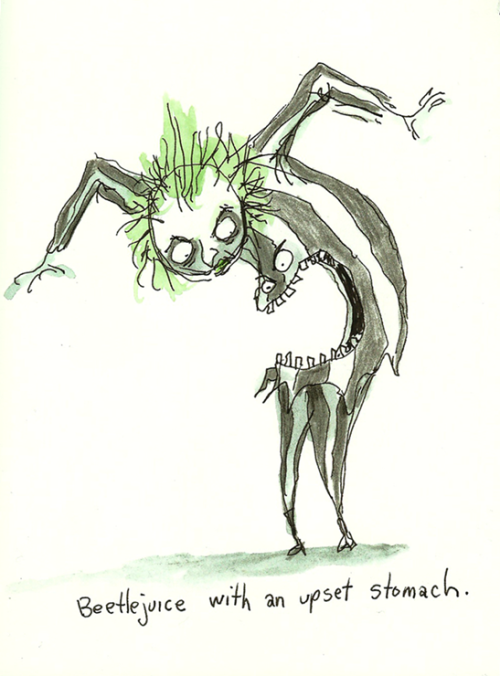
But the real star of this movie is Michael Keaton as the bio-exorcist and titular Beetlejuice.  I really can't stress enough how fantastic he is in this film.  In every scene, he jumps off the screen.  He plays the part as a used car salesman meets the Genie.  He's a mad tornado of crass and filth.  Keaton was robbed at the Academy Awards last year for his brutally honest performance in 'Birdman' but he wasn't even nominated for his performance in this.  Unforgivable.


Legend says that following the surprise success of 'Pee-wee's Big Adventure', Burton began searching for a new project to pursue.  However, he was despondent after script after script of unoriginal ideas.  He was about to give up hope, when at the bottom of a mountain of listless screenplays, he found a concept bursting with unique imagery that fit Burton like a glove.

The Production Design by Bo Welch, the Art Direction by Tom Duffield, the Set Decoration by Catherine Mann, the Costume Design by Aggie Guerard Rodgers, and the Makeup by Ve Neill, Steve LaPorte, and Robert Short, for which they won an Oscar, are all top notch.  The effects aren't perfectly polished.  At no point, do I forget that we're on sets on a soundstage somewhere, but that's part of the charm.  It's all rough and tumble.

The score by Danny Elfman is iconic.  Whenever anyone makes a movie about conniving spirits, this theme is bound to show up in the trailer or TV spots and for good reason.  Like the characters, the scenery, the special effects, and everything else about the movie, its chock full of personality.

Burton directs this story with a precise deliberation and a fantastic imagination.  The stop-motion animation, particularly a snake within a snake that looks like something from 'Dune.'  His excitement and love for every aspect of filmmaking is tangible and I spent most of the movie grinning ear to ear.  There's a scene at the dinner table involving a choreographed dance sequence, shrimp cocktails, and the Banana Boat Song by Harry Belafonte.  The last act in particular, when Beetlejuice makes his way into the human world, is a hilarious thrill ride.  When I saw this film as a kid, I remember not laughing.  Not because it wasn't funny, it is, but because I couldn't understand what I was watching.  What is happening in this movie?  Its unexpected, unpredictable, and wholly original.  I can't imagine NOT liking this film.  It's a blast.


Extra Tidbit.  Some crazy individuals with too much time and even more talent made an awesome Beetlejuice Rollercoaster in Minecraft.  Check it out here...

Oeuvre: Tim Burton - Pee-wee's Big Adventure

Once upon a time, there was a school called CalArts.  In this school, legendary Disney animators, men of great talent who worked with Walt himself, met in classroom A113 to teach a new generation of talented youngsters the art of animation.  These artists would grow to change the face of the industry forever.  They included Pixar founder, John Lasseter, Iron Giant director, Brad Bird, stop-motion titan, Henry Selick, and a shy, thin, quiet young man with dark clothes, tangly, wiry hair, and an affinity for German expressionism named Tim Burton.

Shortly after graduating, Burton and several other students went to work for the Mouse House and Burton was given the chance to direct a short film of his own creation.  The film, 'Frankenweenie', which we will get to eventually, was deemed "too dark for children" and Burton was fired.  But all was not lost, for a man named Paul Reubens saw the movie.  Impressed with this up-and-coming director's visual style, Reubens offered Burton the chance to direct his first feature film based on a television show Reubens conceived and starred in.  Burton agreed and that brings us to 'Pee-Wee's Big Adventure.'


The world that Pee-wee inhabits must seem alien and Neverland Ranchy to the uninitiated but I will try my best to explain.  Pee-Wee is a grown man with the mind of a child.  He is not mentally retarded, rather he has in him the spirit and logic of youth.  This is never expressly stated, but the movie does its best to convey, from his amazing house complete with fire pole, a Breakfast Machine that would make Rube Goldberg's mouth water, and a secret room hidden in a hedge containing Pee-wee's most prized possession, his Bike, that Pee-wee lives in the best possible world as perceived by a child.  Adults behave how children perceive them to behave.  Serious at one moment and silly the next, to the eye-rolling embarrassment of Pee-Wee.  "If I were grown up, this is how things would be!"

Pee-wee's bike, the envy of all, is stolen during one of Pee-wee's daily trips to the Magic Shoppe.  The Police won't help and so Pee-wee embarks on a cross country road trip to reclaim his lost treasure.

Reubens is really a marvel as Pee-wee Herman.  He has been playing the part for almost 35 years now.  The character is an absurd creation.  Mathematically, it should be creepy and yet, it works.  Its entirely possible that Pee-wee Herman is the perfect vessel for this sort of performance.  Can you imagine Paul Reubens bringing that sort of logic to Willy Wonka?

The screenplay by Paul Reubens, Michael Varhol, and the late, great Phil Hartman is brimming with energy and humor.  It hops from one small story to the next with a feverish determination.  In a mere 90 minutes, we are treated to dinosaurs, water wrestling, an escaped convict with a real dark past, singing hobos, clown doctors, a bucking bronco, the Alamo, a leather clad biker gang, and a ghost story from a trucker named Large Marge, my personal favorite.  There's so much more going on in this movie, almost too much, but the throw-it-at-the-wall-and-see-what-sticks approach really works to this film's benefit.

Reubens was all, "Your loss, Disney," and gave the Disney reject the opportunity to direct his very first feature film. That Disney reject was Tim Burton.

If you watch Frankenweenie or any of Burton's college shorts like 'Vincent', you can see that Burton's vision was sharply defined even at a young age.  However, his trademark style is not fully apparent here, though glimpses of his skewed doors and preference for black and white stripes do appear here and there, as does his love of stop-motion animation.  The production design by David L. Snyder is fun and the editing by Billy Weber is fine.  Weber has edited Days of Heaven, The Warriors, Beverly Hills Cop, Top Gun, Midnight Run, The Thin Red Line, Miss Congeniality, The Love Guru, and The Tree of Life.  What a strange career that man has had.

The only part of this movie that is definitively Burton is the score by lead singer of Oingo Boingo, Danny Elfman.  The soundtrack is bouncy and robust though far more lighthearted than his more iconic scores we will hear in the near future.  

Overall, 'Pee-wee's Big Adventure' is a fun film with a great sense of imagination and a slightly tweaked universe.  Burton directs with a firm hand and there's never a moment where I felt like he didn't know what he was going for.  This is by no means a "substantial film" but it is a good time.

Wednesday, March 25, 2015

Oeuvre: Mel Brooks Retrospective

As I said in my first review, the Oeuvre project was just something that I started with a friend to keep in touch, as well as keeping our critical minds sharp, and to give us a chance to explore and revisit films we might never have watched otherwise.  

For the past month and a half or so, I've been watching and reviewing the films of Mel Brooks.  I had heard of almost all of his work but I had never seen most of them and exploring unknown decades of his career was intriguing.


Its always interesting to watch a director change over time.  Whether they evolve or stagnate.  As long as I've known about Mel Brooks, I've known him as a comic legend.  The common man equivalent to Woody Allen.  There was even a debate over which of these New York Jewish comedians was "better" on 'Siskel and Ebert.'  (http://siskelandebert.org/video/8R52X9UUUHXO/Sneak-Previews--Mel-Brooks-or-Woody-Allen-1980)

Is that reputation justified?  Somewhat.  Do I think he's worthy of his iconic status?  Sort of.  After watching all of his films, I can definitively say, he's more visual than Allen.  In fact, his visual flair may be Brooks' greatest asset.  He's not a auteur but he has an eye for the sight gag and his passion for meta humor must have been revolutionary.  He had a talent for surrounding himself with and reusing talented performers such as Gene Wilder, Madeline Kahn, Cloris Leachman, Harvey Korman, Marty Feldman, and Dom DeLuise.  These casting favorites, along with a long career as a parodist gave Brooks a brand he would live by for the rest of his career.  I don't think he integrated himself as a star of his own films as successfully as Allen, in fact I think it was often a detriment to his material.  Perhaps his films would have been stronger with someone else in front of the camera.  And unfortunately, that self-imposed label as a parodist would haunt him.  I firmly believe that the only reason 'Life Stinks' is treated with such vehement disregard is because it is such a radical departure for him. 

When I think of Mel Brooks at his best, I think of self-referential comedy, broad slapstick, gross-out jokes, social commentary, and a love of the absurd.  Of all his films, I think 'Blazing Saddles' is the one that best encapsulates his career.  It deftly blends satire of the Western genre with an undercurrent of racisms and general prejudice.  Its climax is the most self-aware Mel Brooks has ever gotten without tripping over himself, and the screenplay sparkles with line after line of quotable material.


Its hard to watch his career from beginning to end without thinking about his influence but also about how time seemed to pass him by.  While he was making 'High Anxiety', the Zucker Brothers were about to hit it big with the absurdist parody 'Airplane!'  A year after he retired with 'Dracula: Dead and Loving It', Wes Craven released one of my favorite horror/self-aware comedies, 'Scream' and only a few years after that, Keenen Wayans released 'Scary Movie' which itself felt like a Brooks style parody of Scream.  We reached a whirlpool of parody circling parody, a snake eating its own tale.  I can't help but think of Brooks as one of the grandfathers of that style of comedy.

Brooks had a legendary rise to stardom as a comedic filmmaker with The Producers, winning best original screenplay for his first film.  How many can claim that?  Diablo Cody is the only name that comes to mind.  Though his star dwindled and faded away with flops towards the end, its clear how numerous films of his wind up on multiple Greatest Comedies of All Time lists.

For good or ill, hilarious or mind-numbingly terrible, his films were consistently his.  And that's one of the greatest compliments I can pay any director.

***

Up Next!

Oeuvre: Mel Brooks - Dracula: Dead and Loving It

After 'The Twilight Saga', everyone seemed in agreement that vampires were overexposed.  A common complaint lobbed at the the series (one of many) was that Edward Cullen and his ilk had nothing in common with vampires, except that they had sharp canines and an occasional thirst for blood.  "Vampires don't sparkle!" they cried.  "You make vampires look silly!"  Poor devils.  If only they'd seen Gary Oldman's hairdo in Francis Ford Coppola's 'Bram Stoker's Dracula' then they'd see how silly a vampire could really look.  Apparently, Brooks thought Oldman looked ridiculous as well for he set out to make his own Dracula parody just shy of the 100th anniversary of Bram Stocker's original novel.  And so, we finish off the films of Mel Brooks with his 1995 box office bomb, 'Dracula: Dead and Loving It.'


The plot closely adheres to most tellings of the Dracula tale.  A solicitor named Thomas Renfield travels to Transylvania to meet with Count Dracula over a real estate deal (no, really).  Dracula reveals himself to be a vampire and hypnotizes Renfield, making him his bitch before traveling to London to... suck some hot bachelorette neck, I guess.

Lets get all the Dracula puns out of the way.  It sucks.  Its lifeless.  It has no teeth.  It's a stake in the heart of Mel Brooks' career.  Bela Lugosee-something-else.  Yada yada yada.  The fact of the matter is that the film isn't very good.  Its more than not very good.  It's terrible.  It's a waste of time.  It's not very appealing to look at.  The cinematography, production design, special effects, and sets look simultaneously expensive and Party City cheap.  For a 90 minute runtime, it feels interminably long and what's worse, its boring.

But the devil is in the details.


Leslie Nielsen plays the titular Dracula.  He is humorous in his effortless Leslie Nielsen way and his comic timing is as impeccable as ever.  He finds a comfortable spot between Bella Legosi, Christopher Lee, and Gary Oldman but despite his decent Bela Lugosi impression, he never creates his own Dracula.  He's just Leslie Nielsen in a Halloween costume.

Peter MacNicol gives Brad Dourif a run for his money as Top Creep.  He starts the film steady as a weak-stomached, extremely British Renfield, but once he falls victim to Dracula's trance he turns into this horrible, screeching mess.  Every minute he was on screen, I wanted to staple my eyes shut.

Amy Yasbeck returns as Mina.  She has worked with Brooks before, plus she is pretty and has a long neck.  However, she has given nothing to do until the last act when she too falls under Dracula's spell.  Her crowning moment is a dance scene between her and Dracula with wirework out of 'Crouching Tiger Hidden Dragon.'

Mel Brooks plays Professor Van Helsing and yup... that's about it.

The only shining light in this film is Steven Weber as Harker, Mina's husband-to-be.  He is the only character who consistently made me smile.  A friend of mine suggested that he may be struggling with a deeply buried homosexuality.  I think he's just fantastically repressed by the times and wants to grab some tit.  His restrained desperation never ceases to be amusing.  He's an oasis in this comedic sahara.

Nielsen stands out in this movie, not because he's particularly good or bad but because he is a legend of parody.  Thanks in no small part to 'Airplane!' and other Zucker Brothers comedies, Nielsen's deadpan delivery and stretchy visage make him instantly recognizable as a satirical icon.  He just doesn't belong in this movie.  He sticks out like a sore thumb and his casting feels like a desperate attempt on Brooks' part for a safe bet.

With 'The Twelve Chairs', Brooks introduced the world to Frank Langella.  Most people don't know this, but Langella played Dracula in 1979.  Why couldn't Brooks bring him back for this, as a knowing wink to the audience?  He was probably busy filming 'Junior.'


This movie is so cheaply made, it's baffling.  In the very beginning of the movie, we see a carriage riding in broad daylight.  Then a shot of the red sunset.  Then a shot of the carriage in broad daylight again.  Its that sort of carelessness that envelopes the film with a lingering scent of "who gives a shit?"  None of the characters have character except for Steven Weber and Leslie Nielsen and even he's just playing himself.  Its impossible to understand what's really going on because nobody has personality, fears, or desires, except "wouldn't it be sad if this woman I told you I loved became a vampire?"  All this could be salvaged if there was a sharp wit to the dialogue but Brooks just replaces the "Your name sounds like something else" jokes from 'Spaceballs' and 'Robin Hood' with the surprisingly less amusing "Aren't accents funny?" jokes.


This is not the worst movie I've ever seen.  Its not even the worst comedy I've seen this year (I'm looking at you, 'Hot Tub Time Machine 2!').  But its really amazing how much work can go into something and the finished product still looks like garbage.  I've always found the process of making comedies fascinating.  Unlike theater or live studio audience sitcoms, you can't tell if something's funny or not until you release it.  You tell a joke on film and nobody can laugh until the director calls "cut!"  I imagine you must feel incredibly stupid jumping around and screaming while dozens of crew members stand stone faced.  And how embarrassed must you be, when the film is released, and all those pin drop quiet, laughless moments are magnified a thousand times?

When 'Dracula: Dead and Loving It' was released, it received universally negative reviews, as well it should.  For a thirty million dollar budget, it only made ten at the box office.  This brought about a firm and decisive end to Mel Brooks directing career.  Not with a bang but with a whimper.

Tuesday, March 24, 2015

Oeuvre: Mel Brooks - Robin Hood: Men in Tights

For the first time in over two decades, Mel Brooks made an original film.  Unfortunately, 'Life Stinks' was a flop in every sense of the word, so, Brooks returned hat in hand to his comfort zone of spoofs with 'Robin Hood: Men in Tights.'


The plot of the story will be familiar to you, even if you haven't seen the Kevin Costner film.  The dashing Robin of Loxley returns from the Crusades to find Rottingham under the tyrannical rule of the corrupt Prince John.  With the help of his Merry Men, Robin Hood must fight to restore order to the kingdom and win the heart of the fair Maid Marian.

Its impossible to ignore the feeling that Brooks is coasting on this one.  There is a constant feeling of "Fine! You like my older parodies?  Well here is exactly what you're expecting!" that never leaves the film.  He's constantly peppering in elements and even direct jokes from his pervious movies.  Prince John's ever-repositioning mole is just a retelling of Igor's hump.  He even exclaims, "I have a mole?!" like how Igor famously asked, "what hump?"  The Sheriff orders Robin Hood to "walk this way!" and they mimic his pompous strut.  The tune for "Men in Tights" is note for note the tune for "Jews in Space."  Mel looks directly at the camera and says, "It's good to be the King."  Dave Chapelle stares down the lens and name-drops Blazing Saddles.  A camera breaks through a glass window after a push in shot like in 'High Anxiety.' And a gaggle of disgruntled peasants scream, "Leave us alone, Mel Brooks!"

Maybe that's the key.  Maybe this is the ultimate parody.  Maybe Brooks isn't just lampooning 'Robin Hood: Prince of Thieves' but his own filmography, challenging the nature of parody, self-referential humor, and the separation of an artist from his content.  Nah, I think he's just lazy.

Brooks receives primary writing credit along with J. D. Shapiro and Evan Chandler.  The former went on to write 'Battlefield Earth' and the latter went on to write nothing else and then died.  You tell me which was the good career move.


And yet, everybody in the cast seems to be aware that the script is less-than-stellar and they counter by throwing themselves into their roles as broadly as possible, working their asses off to wring every drop of comedy they can out of this hot and cold screenplay.

Cary Elwes is Robin Hood and it is perfect casting.  He may be the most charismatic actor to play the part since Errol Flynn.  As 'The Princess Bride' showed, Elwes was born to play dashing, confident swashbucklers.  Unfortunately, Hollywood wasn't making that type of movie anymore, so he's stuck with this.

As Maid Marian, Amy Yasbek is torn between being the respectable maiden society demands and being horny as hell.  Her assistant, Broomhilde played by Megan Cavanagh is a retread of Joan River's character in 'Spaceballs' but with actual character and jokes.

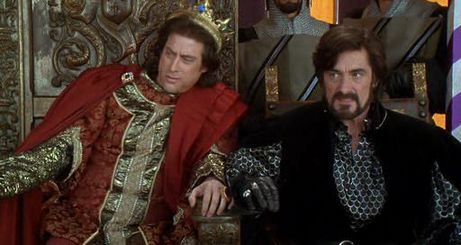
While many play Prince John as a contemptuous, Prince Joffrey-esque prick or sniveling, thumb-sucking coward, Richard Lewis plays the part like the head of a Las Vegas casino.  Its a fresh take that gives his performance a classless texture.

Mark Blankfield gives Mr. Magoo a run for his money as the funniest blind character and Robin Hood's loyal servant.  Mel Brooks cameos as a Rabbi trying to sell the people on circumcisions (a few laughs there), Tracy Ullman is fun as a nasty witch/cook with the hots for the Sheriff.  Oh and Patrick Stewart shows up.

Roger Rees is tasked with playing the pathetically smarmy Sheriff of Rottingham and he commits fully.  There is no fear in this man.  He has the broadest range of emotions, from smug self-satisfaction, to spluttering exasperation, to red-faced fury, to perverted frustration, arousal, and disgust.  He probably comes out of the movie with the most laughs, and for good reason.  He's hilarious.

The real wild card of the bunch is Dave Chapelle in his big screen debut.  I can't tell if he's happy to be in this movie or not but he's definitely done with this Ahchoo joke.  He seems to have a special skill set which is making black jokes and anything outside of it, like a choreographed dance number, makes him visibly uncomfortable.


Its hard not to think of this as a step back for Mel's career after the original film 'Life Stinks' but the movie works more often than it doesn't and it terms of his previous parodies, it far outstrips 'Spaceballs.'  One of the reasons this movie is successful is that the story of Robin Hood lends itself to comedic interpretation far more easily than Star Wars.  The story and those in it have been passed down for centuries and retold dozens and dozens of times, in Errol Flynn's 1938 classic, Disney's 1973 family film, or Ridley Scott's 2010 catastrophe.  Nottingham, Merry Men, "steal from the rich and give to the needy" are all ingrained in cultural history.  Robin Hood is as well known as Darth Vader, but while Rick Moranis had to warp the icon to make him comedic, everyone in Men in Tights simply play heightened versions of their characters.  Lone Starr is just a generic hero but Robin Hood is well-defined by legend and so are his relationships.

In general, the writing is just sharper.  I'll never laugh at Pizza the Hutt.  But for every eye-rolling "your name sounds like another word" joke that Brooks is overly fond of telling, there is one of genuine cleverness.  When Rabbi Tuckman can't convince any of the Merry Men to partake in a ritual circumcision he sighs, "I've got to work on a younger crowd."  And a scene involving a metal glove will never fail to make me laugh.

In an ideal world, Brooks could have skipped all of his films in between and just made this right after 'Young Frankenstein.'  Its obviously a parody but it almost works as its own retelling of the Robin Hood myth.  Then he could have made 'Life Stinks' and moved on to wholly original films.  Alas.  Men in Tights has a cult following now but it was only a moderate success at the time.  Brooks thought a parody of Robin Hood was a safe bet, but the age of his particular brand of parody was coming to a close.  The noose was tightening and his next and final film was the nail in the coffin.